
The short answer
Yes, when the enzyme matches the food. Lactase for dairy and alpha-galactosidase for beans have real trials. Prescription pancreatic enzymes work for diagnosed deficiency. But an enzyme acts on one meal, while everyday bloating usually comes from fermentation in the large intestine. That's where a daily gut-support habit fits.
The bottle says "digestive enzymes" and lists a dozen of them. Most health sites answer with a shrug: little evidence for most people, except lactase and Beano. True, and not useful. It never tells you which enzyme goes with which food, how to read the units, or why an enzyme can't touch bloating that shows up every afternoon whatever you ate.
What does a digestive enzyme supplement actually do?
An enzyme is a tool with one job. Lactase splits lactose, the sugar in milk. Alpha-galactosidase splits the raffinose-family sugars in beans and cabbage. Lipase splits fat. Each works on its own target and ignores the rest of the plate.
The job also happens at a specific time and place: in the small intestine, while the meal is passing through. An enzyme taken with breakfast is gone by lunch. It changes one component of one meal, once, and leaves your gut and your bacteria as they were.
Do digestive enzyme supplements work? Which enzyme for which food
Here is the table the shrug answer never gives: the food or symptom, the enzyme that targets it, the unit on the label, and how strong the evidence is. Rows are based on a study or a clinical source; foods listed together share the same hard-to-digest sugar.
| Food or symptom | Matching enzyme | Label unit | Evidence |
|---|---|---|---|
| Milk, ice cream, soft cheese | Lactase | ALU | Good. Crossover trial (each patient tried every option), 30 patients: symptom score fell from 3.7 to 1.0 or less.[2] |
| Beans, lentils, broccoli, cabbage | Alpha-galactosidase | GalU | Limited. Placebo-controlled, 8 healthy volunteers: 1,200 GalU with a bean meal cut breath hydrogen and flatulence.[3] |
| Fruit, honey, sweetened drinks (fructose) | Xylose isomerase | Units vary by brand | One trial. 65 patients with fructose malabsorption: breath hydrogen less than half of placebo; pain and nausea improved; bloating improved too, but not by enough to rule out chance. Funded by the enzyme's maker.[4] |
| Bread, pasta (gluten, non-celiac sensitivity) | AN-PEP (a prolyl endoprotease) | Units vary by brand | Early. 18 gluten-sensitive volunteers: most gluten broken down in the stomach (gluten was measured, not symptoms). Not tested in celiac disease; partly funded by the enzyme maker.[5] |
| Fatty, floating stools; weight loss | Prescription pancrelipase (PERT) | USP units of lipase | Strong — prescription only. Standard treatment for exocrine pancreatic insufficiency, taken with every meal.[6][7] |
| Bloating most days, any meal | No matching enzyme | — | Usually fermentation in the large intestine[8] or a muscle reflex. See below. |
Share of people in the United States with lactose malabsorption — the small intestine doesn't split all the lactose they eat. Worldwide, about 68%. That is why lactase is the enzyme everyone agrees on: common target, specific enzyme.
National Institute of Diabetes and Digestive and Kidney Diseases, "Definition & Facts for Lactose Intolerance"The lactase trial shows what "works" looks like when the match is right. Thirty adults with confirmed lactose malabsorption drank 400 ml of milk (about 13 ounces) plain, with 3,000 units of lactase added ten hours ahead, or with 6,000 units added five minutes ahead. Breath hydrogen, the gas marker, dropped by roughly three-quarters with either dose. The symptom score for bloating, pain, gas and diarrhea fell from 3.7 to 0.4 and 1.0.[2]
The bean study points the same way. Eight healthy volunteers ate 420 grams of cooked beans, close to 15 ounces, with placebo or one of two doses of alpha-galactosidase. The higher dose, 1,200 GalU, significantly reduced breath hydrogen and flatulence; both doses lowered the total symptom score.[3] Eight people is a lead, not a verdict.
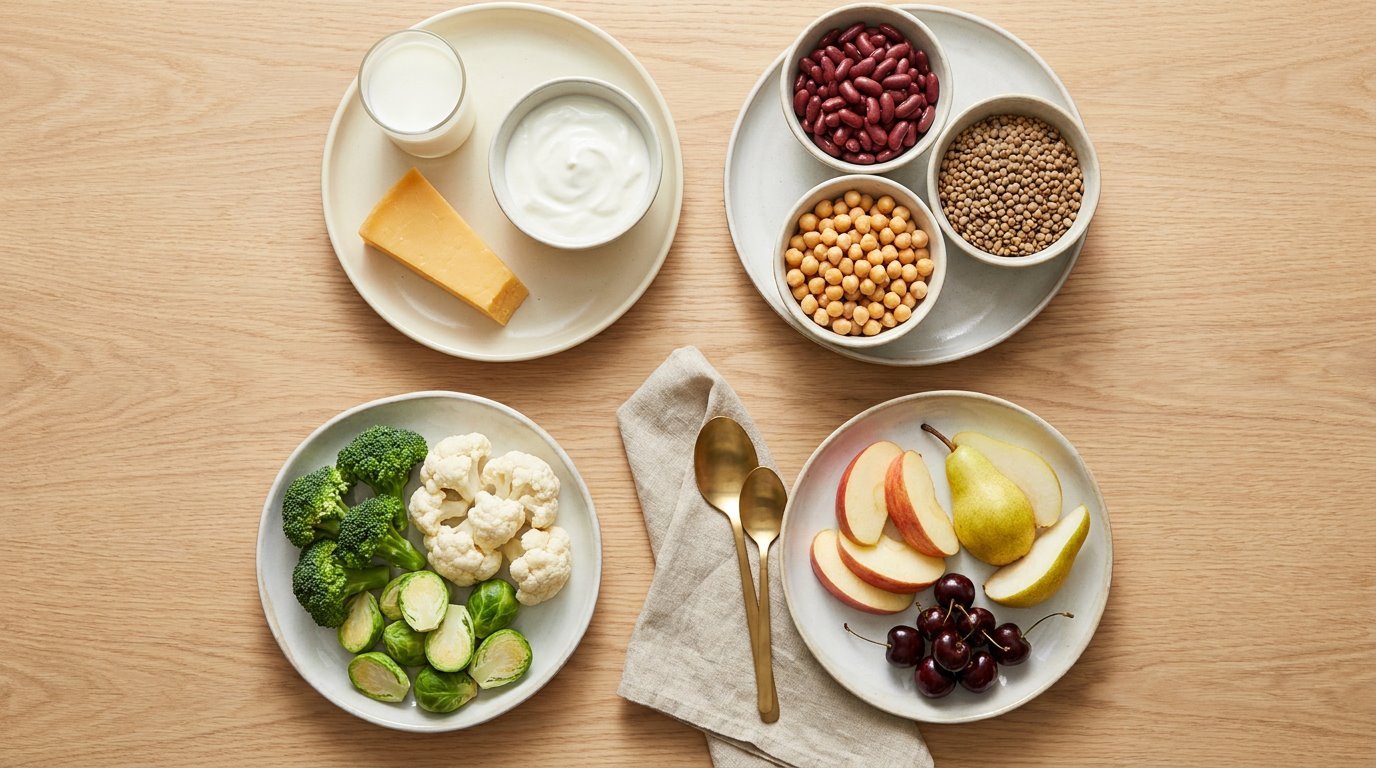
Why doesn't an enzyme fix everyday bloating?
Here is the distinction that gets skipped. The enzyme works upstream, in the small intestine, on the meal you took it with. Most gas is made downstream: carbohydrates "the stomach and small intestine don't fully digest" reach the large intestine, where, in the NIDDK's words, "bacteria break them down and create gas in the process."[8]
That fermentation is normal. It's how fiber feeds the gut, and it rises and falls with how much fermentable material arrives and how your bacteria handle it. None of that is an enzyme deficiency, so none of it has an enzyme fix. If the bloating followed a recent jump in vegetables or fiber, it usually settles as the gut adapts (see why more vegetables make you bloated).
A lot of daily bloating isn't gas at all. The belly that's flat in the morning and pushed out by dinner is often a muscle reflex, the diaphragm pressing down while the abdominal wall relaxes. The pillar guide explains how to tell the two apart, and this article covers the evening pattern. An enzyme has no effect on a reflex.
How do you read an enzyme label?
Enzymes are measured by activity, not weight. Two capsules can hold the same milligrams of "lactase" and do very different amounts of work, so the useful number is the one that measures work.
- ALU — acid lactase units, the unit most lactase supplements list. The milk trial measured its lactase in international units: 3,000 and 6,000 for about 13 ounces of milk.[2]
- GalU — galactosidase units, for alpha-galactosidase. The bean study's effective dose was 1,200 GalU for a very large serving.[3]
- FCC units — the Food Chemicals Codex standard for most other enzymes, each with its own abbreviation (HUT for proteases, DU for amylase). The letters change; the idea is the same.
- USP units of lipase — how prescription pancreatic enzymes are dosed. Adults with exocrine pancreatic insufficiency generally need 25,000 to 50,000 units of lipase per meal to control fatty stools.[7] A medical dose set by a doctor, which is why that row is prescription-only.
The reading rule is short. Find the enzyme that matches your trigger food, check that the label states its activity in the right unit, and compare that number with the dose a trial used. Enzyme products don't go through FDA approval before they're sold,[10] so for enzymes the activity unit is the closest thing to a promise you can check.
What about enzyme blends that list several enzymes at once? We found one randomized trial: 40 people with functional dyspepsia, an upper-stomach discomfort rather than bloating from a food, took a blend or placebo for 60 days and reported better symptom scores. Every author was a founder or employee of the company that sells it.[9] One company-run trial is a starting point, not proof.
Enzymes vs. probiotics vs. synbiotics: which one for bloating?
Most pages treat the three as rival brands of the same thing. They aren't. They act on different targets, on different timescales, for different problems.
An enzyme acts on the meal. One sugar, one food, within hours, and nothing the next day. It's the direct tool when a single food is the cause.
A probiotic acts on the gut. It adds live cultures, and any effect is judged over four to eight weeks, tied to the specific strain tested. We went strain by strain in do probiotics actually help with bloating.
A synbiotic pairs a prebiotic fiber with live cultures in one product, so the fiber feeds the bacteria you're adding. It's a daily-support category, not a meal-rescue category, and it sits alongside a plate that already brings fiber (our fiber guide covers how much).
When is bloating not an enzyme problem?
When it doesn't track a food. For one week, note what you eat and score your bloating morning and evening. If it spikes after dairy and stays quiet after everything else, you've found your row in the table. If it arrives most days by late afternoon whatever you ate, no row applies; that's the pattern the pillar guide calls Loop 1.
So if the bloating shows up every day, and not only with milk or beans, a simple daily gut habit fits better than an enzyme: prebiotic fiber plus live cultures, alongside a plate that already has fiber on it.
Where a daily gut habit fits
Enzymes handle the meal. A daily synbiotic is the habit for the days in between.
This is where a synbiotic enters: not the meal, but the everyday routine. That's where consistent daily gut support fits, and a once-daily capsule is the simplest way to keep the habit going.
SLIMTIDE is a once-daily synbiotic capsule: prebiotic fiber plus live cultures in one pill, as a simple daily gut-support habit that complements a fiber-rich plate. It's made in the USA in an FDA-registered, GMP-certified facility, is non-GMO, contains no caffeine or stimulants, and comes with a 60-day money-back guarantee — two months to run your own test, with fine print worth reading first: use it at least 30 days, and return shipping is on you.
Might make sense if
- Your bloating follows a daily pattern rather than one trigger food
- You'd rather take one capsule than measure fiber powder and a separate probiotic
- You want a 60-day money-back guarantee while you test it
- You value a US-made, GMP-certified, non-GMO product
Skip it if
- Your bloating only happens with one specific food — a matching enzyme is the more direct tool
- You take prescription pancreatic enzymes — keep following your doctor's plan
- You're looking for a stimulant or an immediate energy boost — this isn't that
- You're pregnant, nursing, or on medication — talk to your doctor first
Affiliate link — we may earn a commission at no cost to you. Full disclosure. Our SLIMTIDE review covers the label, price and guarantee.
How do you test an enzyme fairly?
It's the easiest supplement test there is, because the effect is fast and the trigger is known.
- Pick one food and one enzyme. Dairy and lactase, or beans and alpha-galactosidase.
- Take it with the first bites, not after; the trials added the enzyme to the milk or gave it during the meal.[2][3]
- Eat the same meal three times, on separate days, with and without the enzyme, and score gas and bloating for six hours. A clear difference means you've matched enzyme to food. No difference moves you from the "food" column to the "pattern" column.
When should you see a doctor?
Your stools are pale, oily, foul-smelling or floating, or you're losing weight without trying. Those are signs of exocrine pancreatic insufficiency, in which the pancreas doesn't make enough enzymes; the treatment is prescription enzyme replacement with every meal.[6] An over-the-counter product is not a substitute.
Also see a doctor if bloating comes with:Blood in the stool, diarrhea lasting weeks, pain that wakes you at night, anemia, or new symptoms after age 50. If you're considering a gluten enzyme, get tested for celiac disease before cutting gluten; the gluten-enzyme trial did not include celiac patients.[5]
Frequently asked questions
Do digestive enzyme supplements work for bloating?
They work for bloating that follows one specific food. Lactase reduced symptoms after milk in a 30-patient crossover trial, and alpha-galactosidase reduced gas after a bean meal in a small placebo-controlled study. Bloating that shows up most days regardless of what you ate usually comes from fermentation or a muscle reflex, not a missing enzyme.
Which digestive enzyme should I take?
Match the enzyme to the food that triggers you. Dairy points to lactase. Beans, lentils and cruciferous vegetables point to alpha-galactosidase. Fruit and sweetened drinks point to xylose isomerase, which has one trial so far. Fatty, floating stools and weight loss point to a doctor. If no single food is the trigger, an enzyme is not the tool.
When should you take digestive enzymes, before or after eating?
With the first bites of the meal that contains the trigger food. Enzymes act on food while it is being digested, so a capsule taken an hour later meets a meal that has already moved on. In the lactase trial the enzyme was added to the milk itself.
Are enzymes or probiotics better for bloating?
They answer different questions. An enzyme acts on one component of one meal, within hours, and does nothing on days you skip it. A probiotic adds live cultures and is judged over weeks, tied to the strain tested. Bloating after dairy or beans points to an enzyme. A daily pattern points to daily gut support.
What do the units on a digestive enzyme label mean?
They measure activity, how much work the enzyme can do, rather than weight. Lactase is listed in ALU, alpha-galactosidase in GalU, and others in units such as HUT or DU, most of them defined by the Food Chemicals Codex (FCC). Prescription pancreatic enzymes are dosed in USP units of lipase. Milligrams alone do not tell you how active the enzyme is.
Can I take a digestive enzyme supplement instead of prescription pancreatic enzymes?
No. Exocrine pancreatic insufficiency is treated with prescription enzyme replacement therapy, taken with every meal and dosed by lipase units, generally at least 25,000 to 50,000 units per meal in adults. Over-the-counter enzymes are not approved for that purpose. Fatty stools, unexplained weight loss or a history of pancreatitis call for a doctor.
Sources
- National Institute of Diabetes and Digestive and Kidney Diseases. "Definition & Facts for Lactose Intolerance." NIDDK, U.S. Department of Health and Human Services. niddk.nih.gov
- Montalto M, Nucera G, Santoro L, et al. "Effect of exogenous beta-galactosidase in patients with lactose malabsorption and intolerance: a crossover double-blind placebo-controlled study." European Journal of Clinical Nutrition, 2005;59(4):489–493. Academic study (Catholic University, Rome); no industry funding listed. pubmed.ncbi.nlm.nih.gov/15674309
- Di Stefano M, Miceli E, Gotti S, et al. "The effect of oral alpha-galactosidase on intestinal gas production and gas-related symptoms." Digestive Diseases and Sciences, 2007;52(1):78–83. Academic study (University of Pavia); no industry funding listed. pubmed.ncbi.nlm.nih.gov/17151807
- Komericki P, Akkilic-Materna M, Strimitzer T, et al. "Oral xylose isomerase decreases breath hydrogen excretion and improves gastrointestinal symptoms in fructose malabsorption — a double-blind, placebo-controlled study." Alimentary Pharmacology & Therapeutics, 2012;36(10):980–987. Funded by Sciotec Diagnostic Technologies, which markets a xylose isomerase product. pubmed.ncbi.nlm.nih.gov/23002720
- König J, Holster S, Bruins MJ, Brummer RJ. "Randomized clinical trial: Effective gluten degradation by Aspergillus niger-derived enzyme in a complex meal setting." Scientific Reports, 2017;7:13100. One coauthor is employed by DSM, which provided the enzyme and partial funding. pubmed.ncbi.nlm.nih.gov/29026170
- Cleveland Clinic. "Exocrine Pancreatic Insufficiency (EPI)." Cleveland Clinic Health Library. my.clevelandclinic.org
- Ianiro G, Pecere S, Giorgio V, Gasbarrini A, Cammarota G. "Digestive Enzyme Supplementation in Gastrointestinal Diseases." Current Drug Metabolism, 2016;17(2):187–193. Authors declared no conflict of interest. pubmed.ncbi.nlm.nih.gov/26806042
- National Institute of Diabetes and Digestive and Kidney Diseases. "Eating, Diet, & Nutrition for Gas in the Digestive Tract." NIDDK, U.S. Department of Health and Human Services. niddk.nih.gov
- Majeed M, Majeed S, Nagabhushanam K, et al. "Evaluation of the Safety and Efficacy of a Multienzyme Complex in Patients with Functional Dyspepsia: A Randomized, Double-Blind, Placebo-Controlled Study." Journal of Medicinal Food, 2018;21(11):1120–1128. All authors are founders or employees of Sami/Sabinsa, which manufactures and markets the product. pubmed.ncbi.nlm.nih.gov/30156436
- U.S. Food and Drug Administration. "Questions and Answers on Dietary Supplements." FDA. fda.gov
This article is for general information and education only. It is not medical advice, diagnosis, or treatment, and it is not a substitute for the judgment of a qualified healthcare provider who knows your history. Fatty or floating stools, unexplained weight loss, blood in the stool, persistent diarrhea, night pain, or anemia should be evaluated by a doctor. If you take prescription pancreatic enzymes, do not replace them with any over-the-counter product. People who are pregnant, nursing, immunocompromised, or taking medication should talk to their doctor before starting any enzyme, probiotic or prebiotic. Always talk to your doctor, registered dietitian, or pharmacist before changing your diet or starting any supplement.
These statements have not been evaluated by the Food and Drug Administration. Any product mentioned is not intended to diagnose, treat, cure, or prevent any disease.