
The short answer
Short sleep raises ghrelin (the hunger hormone) and lowers leptin (the fullness hormone) at the same time. In a controlled study, that shift raised hunger about 24% and cravings for high-carb food up to 45%. You're not weak — your body is running a different appetite program.
You know the feeling. You slept four or five hours, dragged yourself through the morning, and by 10 a.m. you're rummaging for something sweet with a focus you don't have for anything else that day.
Then comes the guilt, which is the worst part — because you assume it's you. It isn't. It's measurable, it's predictable, and once you understand the mechanism you can plan around it instead of losing to it.
Why does bad sleep make you hungry the next day?
Your appetite isn't controlled by willpower. It's controlled by hormones, and two of them are exquisitely sensitive to how you slept.
When you cut sleep short, your body behaves as if it needs more energy to get through the extra waking hours — so it turns up the signals that make you seek food and turns down the ones that tell you to stop. That's the entire story in one sentence. The rest is detail.
Which hormones are actually changing?
Two, working against you at the same time:
- Ghrelin — the "I'm hungry" hormone. It goes up when you're short on sleep.
- Leptin — the "I'm full, you can stop" hormone. It goes down.
So you get hungrier faster and it takes more food to feel satisfied. In 2004, researchers at the University of Chicago put this on a scale. They restricted healthy young men's sleep and measured what happened.
Ghrelin (hunger) rose about 28% and leptin (fullness) fell about 18% after sleep restriction. Self-reported hunger climbed 24%, and appetite for high-carbohydrate foods jumped 33–45%.
Spiegel et al., Annals of Internal Medicine, 2004 (controlled study, n=12)Read that last number again. It isn't just that you're hungrier — your hunger is being aimed at exactly the foods that undo a whole week of effort.
Why do I crave junk food specifically, not just more food?
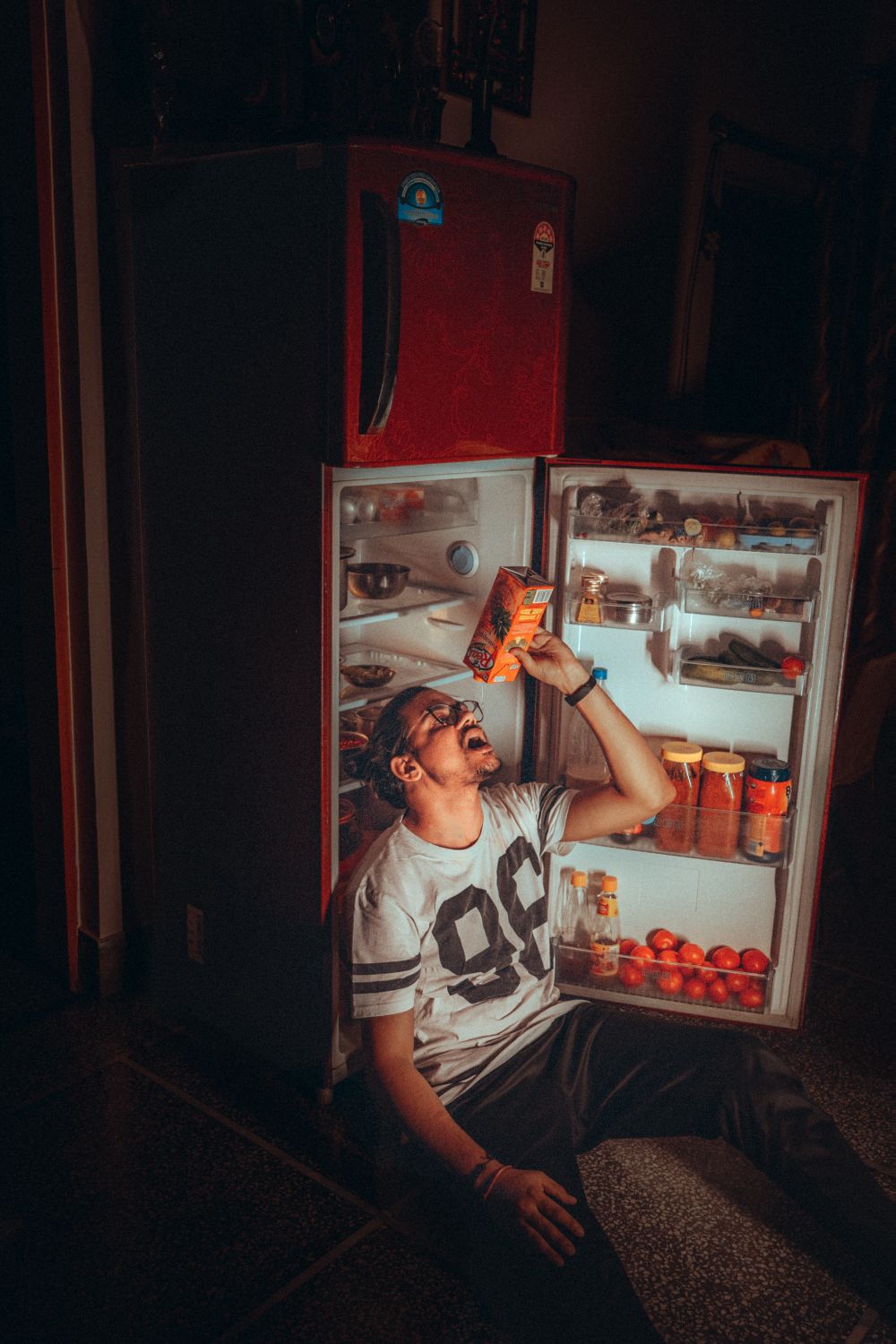
This is the cruel part. A tired body doesn't send you toward an apple. It sends you toward the muffin.
Part of that is the carbohydrate-appetite spike measured above. But there's a second mechanism, and it's in your head — literally.
What does a sleep-deprived brain do with food?
In 2013, a team at UC Berkeley scanned people's brains while they looked at food, both well-rested and sleep-deprived.
Sleep deprivation did two things at once. It dialed down activity in the frontal cortex — the part that weighs consequences and makes sensible decisions. And it dialed up activity in deeper, reward-driven regions that respond to the immediate pull of food.
The result was a measurable increase in desire for high-calorie food, and the effect got stronger the sleepier people felt. So when you're exhausted, the "should I really?" part of your brain is quiet and the "want it now" part is loud. You're negotiating with a stacked deck.
None of this means you're powerless. It means you should stop relying on in-the-moment willpower on tired days, because that's precisely the tool sleep loss disables.
Does one bad night really matter?
For the way you feel tomorrow — yes, one night is enough. That's why the effect is so noticeable.
For your weight — one night is nothing. Nobody gains fat from a single rough night. The danger is the pattern: when short sleep becomes normal, you're stacking extra hunger, sharper cravings, and weaker decisions on top of each other, night after night, and it quietly adds up.
There's a weight-loss angle too. In a separate controlled study, people who slept 5.5 hours instead of 8.5 while dieting lost 55% less fat — their bodies gave up muscle instead. We cover that in the complete satiety guide. Sleep isn't a bonus lever. It's one of the main ones.
What should you eat on a day after bad sleep?
You can't out-discipline the hormones. But you can feed them the one thing that pushes back: fullness that lasts.
1. Protein at breakfast, no exceptions. Eggs, Greek yogurt, cottage cheese. Protein is the strongest fullness signal you have, and it directly opposes the raised hunger hormone. This is the single most useful thing you can do.
2. Add fiber. Berries, oats, a piece of fruit with skin. Fiber slows digestion and stretches out fullness.
3. Decide before you're hungry. Plan lunch in the morning, while your frontal cortex still works. Don't leave the choice for 3 p.m., when it won't.
4. Don't skip meals to "save" calories. Skipping just hands the evening a bigger, hungrier version of the same problem.
The coffee-and-pastry breakfast is the exact wrong move: near-zero protein, a blood-sugar spike, and a crash that leaves you hungrier by mid-morning. On a tired day it's pouring fuel on the fire.
Where supplements fit
Fix the sleep and the food first — here's our honest take on the rest
Readers ask whether a supplement can help with the appetite and energy dips that follow bad sleep. SLIMTIDE is a daily supplement marketed to support appetite control, digestive comfort, and everyday energy alongside a healthy diet.
Might make sense if
- Your sleep and your meals are genuinely in a good place already
- You want extra daily support and your doctor has cleared the label
Skip it if
- You're chronically short on sleep — fix that first, it's the real lever
- You're pregnant, nursing, or on medication (talk to your doctor first)
- You want it to work overnight — give it the full 30 to 60 days
Affiliate link — we may earn a commission at no cost to you. Full disclosure.
How do you actually fix the underlying problem?
Eating well on a tired day is damage control. The real fix is fewer tired days.
You don't need perfect sleep — you need to stop landing under about six hours as a habit. A few unglamorous things move the needle most:
- A consistent wake-up time, even on weekends. Your body clock rewards regularity more than any single long lie-in.
- A wind-down that doesn't involve a bright screen in the last half hour.
- Caffeine with a curfew — nothing after early afternoon. It lingers far longer than people think.
Do that, and the whole cascade in this article — the ghrelin, the cravings, the quiet frontal cortex — simply happens less often. You're not fighting your appetite anymore. You've stopped provoking it.
Frequently asked questions
Why am I so hungry the day after sleeping badly?
Short sleep raises ghrelin (hunger) about 28% and lowers leptin (fullness) about 18%, per a controlled 2004 study. Self-reported hunger rose 24%. The hunger is a genuine hormonal signal, not a willpower failure.
Why do I crave junk food specifically when I'm tired?
Appetite for high-carb food rose 33–45% after sleep restriction in the same study. Brain imaging also shows sleep loss quiets the decision-making cortex and amplifies reward regions — steering you toward calorie-dense food specifically.
Does one bad night really matter, or only long-term sleep loss?
One night is enough to change appetite the next day — that's why you feel it. For weight, it's the repeated pattern that matters, because the extra hunger and worse food choices stack up night after night.
What should I eat the day after a bad night's sleep?
Front-load protein and fiber, especially at breakfast — they're the two strongest fullness signals and push back directly against the raised hunger hormone. Avoid the coffee-and-pastry start, which spikes then drops your blood sugar.
Will I gain weight from being hungrier after poor sleep?
Not from one night. The risk is a repeated pattern of short sleep, which combines more hunger, stronger cravings, and weaker decisions. Protecting sleep is a legitimate weight-management tool.
How much sleep do I need to keep appetite normal?
Most adults need seven to nine hours. The appetite disruption showed up when sleep dropped to around four to five and a half hours. Consistently under about six hours is where the hunger and craving effects appear most clearly.
Sources
- Spiegel K, Tasali E, Penev P, Van Cauter E. "Brief communication: Sleep curtailment in healthy young men is associated with decreased leptin levels, elevated ghrelin levels, and increased hunger and appetite." Annals of Internal Medicine, 2004;141(11):846–850. pubmed.ncbi.nlm.nih.gov/15583226
- Greer SM, Goldstein AN, Walker MP. "The impact of sleep deprivation on food desire in the human brain." Nature Communications, 2013;4:2259. pubmed.ncbi.nlm.nih.gov/23922121
- Nedeltcheva AV, Kilkus JM, Imperial J, Schoeller DA, Penev PD. "Insufficient sleep undermines dietary efforts to reduce adiposity." Annals of Internal Medicine, 2010;153(7):435–441. pubmed.ncbi.nlm.nih.gov/20921542
This article is for general information and education only. It is not medical advice, diagnosis, or treatment. Persistent insomnia, unrefreshing sleep, or loud snoring with daytime exhaustion can signal a treatable sleep disorder — talk to your doctor. Always seek professional advice before changing your diet or starting any supplement, especially if you are pregnant or nursing, taking medication, or managing a health condition.
These statements have not been evaluated by the Food and Drug Administration. Any product mentioned is not intended to diagnose, treat, cure, or prevent any disease.