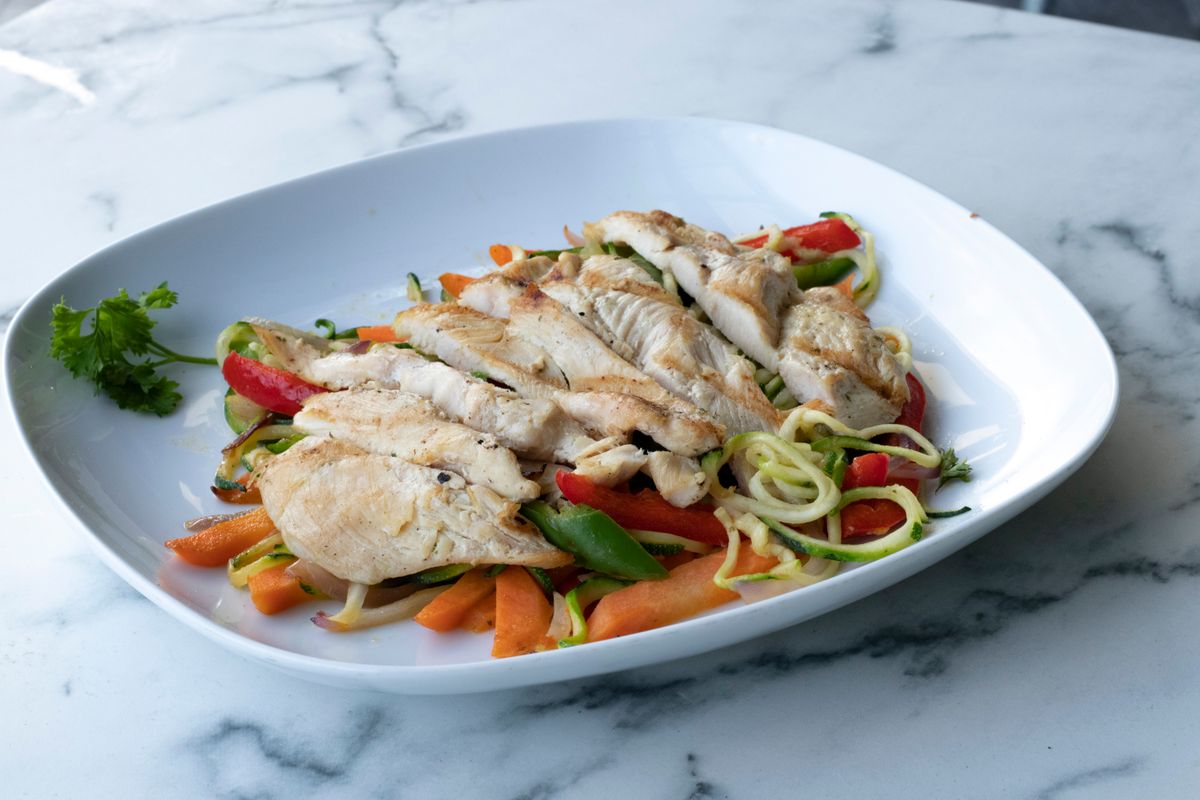
The short answer
Aim for 1.2–1.6 grams of protein per kilogram of body weight per day, spread across meals at roughly 25–30 g each. For a 154 lb (70 kg) adult that's about 84–112 g a day. That's double the RDA minimum — because the RDA is set to prevent deficiency, not to keep you full.
Protein is the only macronutrient people reliably under-eat while actively trying to lose weight. Fat gets cut on purpose. Carbs get cut on purpose. Protein just quietly falls, because the foods that carry it are the ones that take effort to cook.
That's a problem, because protein is doing more work for your appetite than either of the things you're busy restricting.
How much protein do you need per day?
There are two numbers in circulation, and they answer different questions.
The RDA is 0.8 g per kilogram of body weight, according to Harvard's Nutrition Source. That figure is a floor. It's the amount required to keep a healthy adult from developing a deficiency — not the amount associated with staying full, holding onto muscle, or losing fat.
The number that matters for weight loss comes from a 2015 review in the American Journal of Clinical Nutrition: 1.2–1.6 g per kilogram per day, with at least 25–30 g of protein per meal.
| Your weight | RDA minimum (0.8 g/kg) | Weight-loss target (1.2–1.6 g/kg) |
|---|---|---|
| 130 lb / 59 kg | 47 g | 71–94 g |
| 154 lb / 70 kg | 56 g | 84–112 g |
| 180 lb / 82 kg | 65 g | 98–131 g |
| 210 lb / 95 kg | 76 g | 114–152 g |
Look at the gap between those two columns. That's the space most people are living in without realizing it.
What happens if you only change your protein?
This is the study worth knowing about, because of what the researchers didn't ask people to do.
In 2005, a team publishing in the American Journal of Clinical Nutrition put participants on a diet where protein rose from 15% to 30% of calories. Carbohydrate stayed fixed at 50%. Then — and this is the important part — participants were told to eat as much as they wanted. No calorie target. No portion control. No restriction of any kind.
The amount participants spontaneously stopped eating each day, per person, once protein went from 15% to 30% of calories. Body weight fell by 4.9 kg over 12 weeks — with no instruction to eat less.
Weigle et al., American Journal of Clinical Nutrition, 2005;82(1):41–48Nobody in that study was white-knuckling anything. Their appetite simply changed, and the calories followed.
That's the whole argument for protein in one result: it works through your appetite instead of against it. Every diet that asks you to override hunger is competing with a system that has more stamina than you do.
Why does protein fill you up more than carbs or fat?
Three things happen at once:
- It's expensive to digest. A larger share of protein's calories is spent breaking it down than is the case for carbohydrate or fat. Some of what you eat is consumed by the act of processing it.
- It changes your fullness signals. The 2015 AJCN review describes a consistent satiety effect after higher-protein meals — greater perceived fullness and elevated satiety hormones.
- It protects muscle while you lose fat. In a calorie deficit your body will take tissue from wherever it can. Adequate protein biases that loss toward fat and away from lean mass — which matters, because lean mass is metabolically active.
Worth being straight about the limits, though. That same review notes the satiety effect is modest, and that in longer studies the results were mixed, with adherence emerging as the deciding factor. Protein is a real lever. It is not a magic one.
Is there a point where more protein stops helping?
Yes — and it arrives earlier than the supplement industry would like you to believe.
A 2018 meta-analysis in the British Journal of Sports Medicine pooled 49 studies and 1,863 participants to find where the returns run out.
The daily protein intake beyond which additional protein produced no further gains in fat-free mass during resistance training. Past this point, extra protein is mostly just extra calories.
Morton et al., British Journal of Sports Medicine, 2018 (meta-analysis, 49 studies, n=1,863)Put the two findings side by side and the practical range becomes obvious: somewhere around 1.2 to 1.6 g/kg. Below it you're leaving fullness on the table. Above it you're buying costly calories and telling yourself it's strategy.
Does it matter when you eat your protein?
More than the total does, for most people.
The 2015 review's recommendation isn't only a daily number — it's 25–30 g per meal. That distinction matters, because the typical American pattern is a near-zero protein breakfast, a light lunch, and then 60 g dumped into dinner.
Same daily total. Completely different day of appetite.
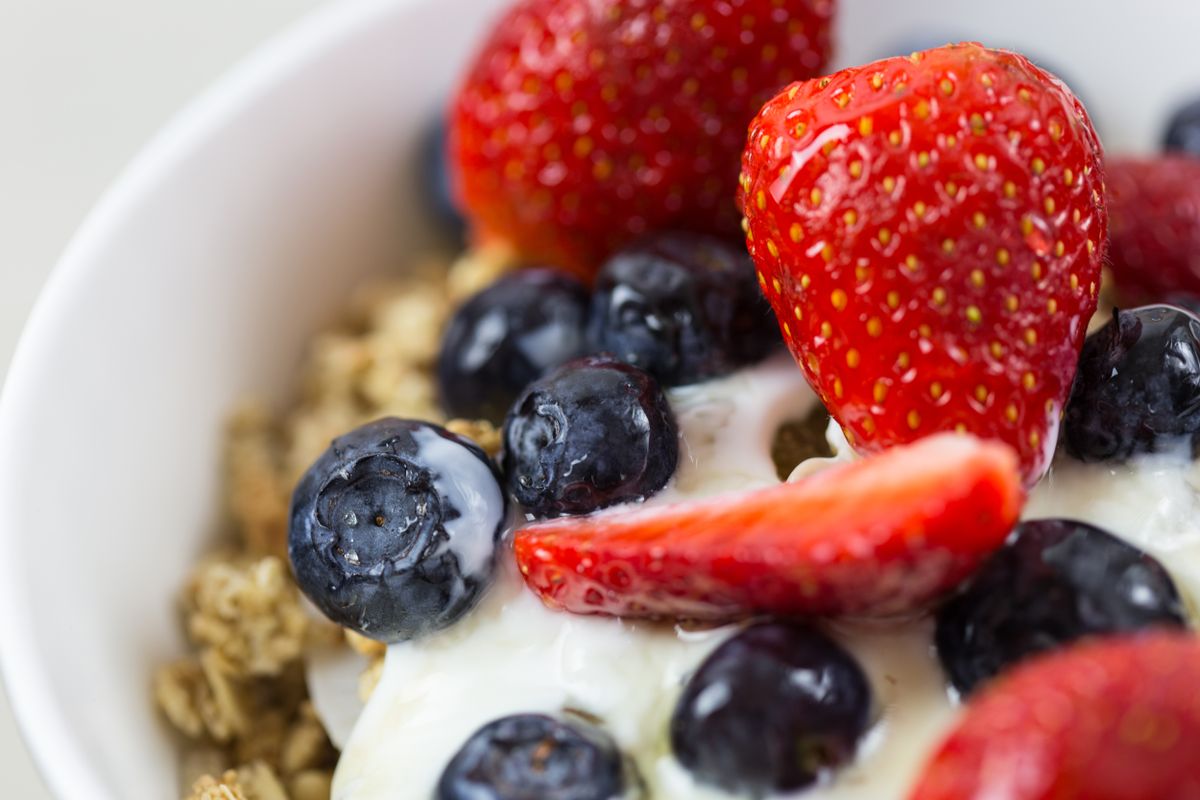
If you change one thing after reading this, change breakfast. It's the meal with the most room and the one that sets up how hungry you'll be at 3 p.m.
Which foods actually get you to 30 grams?
Fewer than you'd think in a single normal serving.
| Food | Serving | Protein (approx.) |
|---|---|---|
| Chicken breast, cooked | 4 oz | ~35 g |
| Tuna, canned in water | 1 can (5 oz) | ~27 g |
| Lean ground beef, cooked | 4 oz | ~26 g |
| Salmon, cooked | 4 oz | ~25 g |
| Cottage cheese | 1 cup | ~24 g |
| Greek yogurt, plain | 1 cup | ~20–22 g |
| Eggs | 3 large | ~19 g |
| Lentils, cooked | 1 cup | ~18 g |
| Tofu, firm | 1 cup | ~20 g |
| Black beans, cooked | 1 cup | ~15 g |
Notice the bottom of that table. Lentils and black beans bring protein and around 15 g of fiber in the same cup — which is why they show up in our fiber guide too. Very few foods work both levers at once.
What does a high-protein day look like?
| Meal | What you eat | Protein |
|---|---|---|
| Breakfast | 1 cup Greek yogurt + 2 eggs | ~34 g |
| Lunch | Big salad + 1 can tuna + 1 cup black beans | ~42 g |
| Snack | 1 cup cottage cheese | ~24 g |
| Dinner | 4 oz chicken breast + vegetables + lentils | ~53 g |
| Daily total | ~153 g | |
That day covers a 210 lb adult at the top of the range. Scale the portions down and the structure still holds: protein at every meal, nothing dramatic, no powder required.
Where supplements fit
Food first — and here's our honest take on the rest
Readers ask whether a supplement can support the appetite side of this. SLIMTIDE is a daily supplement marketed to support appetite control, digestive comfort, and everyday energy alongside a healthy diet.
Might make sense if
- You're already hitting your protein and fiber targets consistently
- You want additional daily support and your doctor has cleared the label
Skip it if
- Your breakfast is still coffee and your protein is under 1 g/kg — start there
- You're pregnant, nursing, or on medication (talk to your doctor first)
- You have kidney disease — protein and supplements both need medical oversight
- You want it to work overnight — give it the full 30 to 60 days
Affiliate link — we may earn a commission at no cost to you. Full disclosure.
Do you need protein powder?
No. It's a convenience, and it's fine to use one.
A shake is genuinely useful when you're travelling, out of time, or staring down a day that isn't going to include cooking. What it doesn't do is fill your stomach the way food does. Chewing time, volume, and water all feed into fullness, and a drink skips every one of them.
Use powder to close a gap on a bad day. Don't build the plan on it.
Is high protein bad for your kidneys?
This deserves a straight answer rather than a reassuring one.
For adults with healthy kidneys, protein intakes in the 1.2–1.6 g/kg range discussed here have not been shown to cause kidney damage.
If you have chronic kidney disease, this article does not apply to you. Protein is often deliberately restricted in CKD, and the right amount is a clinical decision made by your doctor or a renal dietitian who can see your labs. Please don't take a target from a website — including this one — over their guidance.
Frequently asked questions
How much protein should I eat per day to lose weight?
1.2–1.6 g per kilogram of body weight, with 25–30 g per meal, per the 2015 AJCN review. For a 154 lb (70 kg) adult that's roughly 84–112 g a day. The RDA of 0.8 g/kg is a deficiency floor, not a weight-loss target.
Does eating more protein actually make you eat less?
In the 2005 AJCN trial, yes — participants who went from 15% to 30% protein ate 441 fewer calories a day on their own, with no instruction to restrict, and lost 4.9 kg over 12 weeks. The drop was spontaneous, not deliberate.
Is there a point where more protein stops helping?
Yes. A 2018 British Journal of Sports Medicine meta-analysis of 49 studies and 1,863 people found no further fat-free mass gains beyond about 1.62 g/kg/day. Above that you're buying calories, not results.
How much protein is in a chicken breast or Greek yogurt?
A 4 oz cooked chicken breast is about 35 g. One cup of plain Greek yogurt is ~20–22 g, a can of tuna ~27 g, three large eggs ~19 g, and a cup of cooked lentils ~18 g. Most single servings land under 30 g — which is why breakfast is usually the weak point.
Do I need protein powder to hit my target?
No. It's convenient, not necessary. Whole foods bring chewing time, volume, water, and micronutrients that a shake doesn't — and those contribute to fullness on their own. Use powder as a backup, not a foundation.
Is a high-protein diet bad for your kidneys?
For healthy kidneys, intakes in this range haven't been shown to cause damage. If you have chronic kidney disease, it's a different situation entirely — protein is often restricted and the amount must be set by your doctor or a renal dietitian.
Sources
- Weigle DS, Breen PA, Matthys CC, et al. "A high-protein diet induces sustained reductions in appetite, ad libitum caloric intake, and body weight despite compensatory changes in diurnal plasma leptin and ghrelin concentrations." American Journal of Clinical Nutrition, 2005;82(1):41–48. pubmed.ncbi.nlm.nih.gov/16002798
- Leidy HJ, Clifton PM, Astrup A, et al. "The role of protein in weight loss and maintenance." American Journal of Clinical Nutrition, 2015;101(6):1320S–1329S. pubmed.ncbi.nlm.nih.gov/25926512
- Morton RW, Murphy KT, McKellar SR, et al. "A systematic review, meta-analysis and meta-regression of the effect of protein supplementation on resistance training-induced gains in muscle mass and strength in healthy adults." British Journal of Sports Medicine, 2018;52(6):376–384. pubmed.ncbi.nlm.nih.gov/28698222
- Harvard T.H. Chan School of Public Health, The Nutrition Source. "Protein." nutritionsource.hsph.harvard.edu
Protein values are approximate and vary by cut, brand, and preparation. Figures are consistent with USDA FoodData Central.
This article is for general information and education only. It is not medical advice, diagnosis, or treatment. Always talk to your doctor, registered dietitian, or pharmacist before changing your diet or starting any supplement — especially if you are pregnant or nursing, taking medication, or managing a health condition. If you have chronic kidney disease or any condition affecting kidney or liver function, protein targets must be set by your care team, not by a general-audience article.
These statements have not been evaluated by the Food and Drug Administration. Any product mentioned is not intended to diagnose, treat, cure, or prevent any disease.