The short answer
Aim for at least 30 grams of fiber a day. Most American adults eat about 15. Fiber slows digestion, adds volume without calories, and feeds gut bacteria — which is why raising it alone produced real weight loss in a 12-month randomized trial.
Fiber has a branding problem. It sounds like something your grandmother worries about. It is, in fact, one of the most powerful and most ignored tools in weight loss — and unlike almost everything else in this field, there's a clean randomized trial behind it.
How much fiber do you need per day?
The Mayo Clinic's guidance is 21–25 g a day for women and 30–38 g for men. The average American adult eats around 15 g.
That gap is the whole story. Most people are operating at roughly half the fullness support their body is built to expect — and then wondering why they're hungry at 3 p.m.
Our working target, and the one with the strongest trial evidence behind it, is simple: 30 grams a day.
What happens if you only change your fiber?
In 2015, researchers published a 12-month randomized trial in Annals of Internal Medicine. They took 240 adults with metabolic syndrome and split them in two.
One group got the full American Heart Association diet: multiple targets, multiple restrictions, the works. The other group got one instruction — eat at least 30 grams of fiber a day. Nothing about calories. Nothing about fat. Nothing to give up.
Average 12-month weight loss in the fiber-only group — compared with 2.7 kg in the group following the far more complex AHA diet. One positive instruction delivered most of the result.
Ma et al., Annals of Internal Medicine, 2015 (randomized trial, n=240)The authors' own conclusion is worth quoting in spirit: the more complex diet may produce somewhat more weight loss, but a simplified approach emphasizing only fiber is a reasonable alternative for people who struggle to stick with complicated regimens.
Which is most of us. A rule you follow beats a rule you abandon.
How does fiber actually make you feel full?
Three mechanisms, all working at once:
- It slows gastric emptying. Food stays in your stomach longer, so fullness lasts longer.
- It adds volume, not calories. Fiber is largely indigestible. It physically occupies space and triggers the stretch receptors that report fullness.
- It feeds your gut bacteria. Fiber that reaches the colon is fermented into short-chain fatty acids, which are involved in appetite and metabolic regulation.
There's a fourth, quieter benefit: high-fiber food is crowding food. When you're genuinely eating 30 g of fiber, there simply isn't much appetite left over for the stuff that got you here.
Soluble or insoluble — does it matter?
Less than the internet suggests.
- Soluble fiber dissolves into a gel. It slows digestion and is the bigger player in satiety. Found in oats, beans, apples, citrus, barley, psyllium.
- Insoluble fiber doesn't dissolve. It adds bulk and keeps things moving. Found in whole grains, nuts, and vegetable and fruit skins.
Whole foods contain both. Eat beans, oats, berries, and vegetables and you'll get a good mix without tracking a thing. Don't overthink this one.
Which foods have the most fiber?
Legumes win, and it isn't close.
| Food | Serving | Fiber (approx.) |
|---|---|---|
| Split peas, cooked | 1 cup | ~16 g |
| Lentils, cooked | 1 cup | ~15 g |
| Black beans, cooked | 1 cup | ~15 g |
| Chia seeds | 1 oz (2 tbsp) | ~10 g |
| Avocado | 1 whole | ~10 g |
| Raspberries | 1 cup | ~8 g |
| Whole-wheat pasta, cooked | 1 cup | ~6 g |
| Pear, with skin | 1 medium | ~5.5 g |
| Broccoli, cooked | 1 cup | ~5 g |
| Oatmeal, cooked | 1 cup | ~4 g |
| Almonds | 1 oz (23 nuts) | ~3.5 g |
Notice something: a single cup of lentils is half your daily target, costs about a dollar, and brings 18 g of protein along with it. There is no supplement on earth with that resume.
What does a 30-gram fiber day look like?
| Meal | What you eat | Fiber |
|---|---|---|
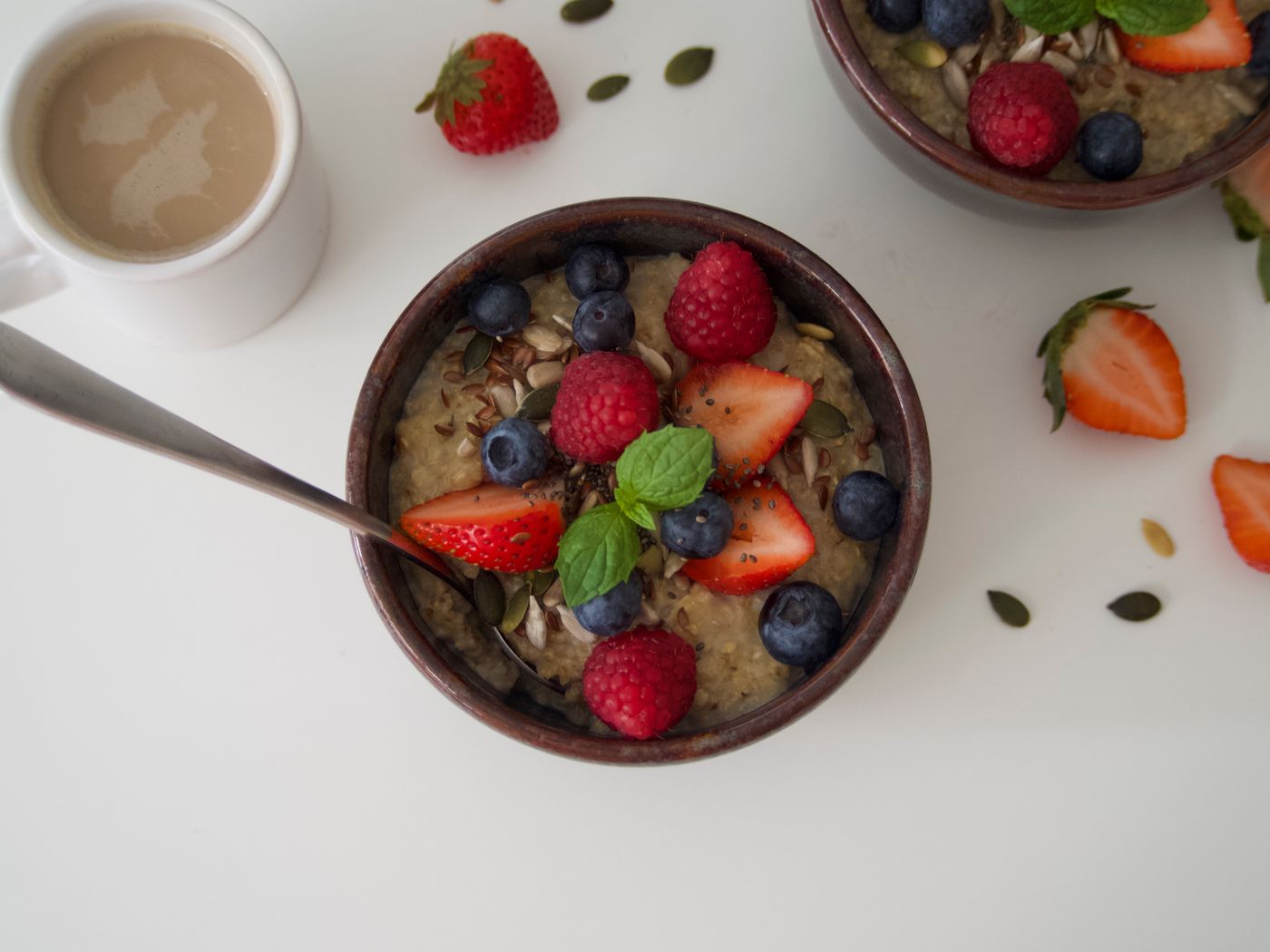
| Breakfast | Oatmeal + 1 cup raspberries + 1 tbsp chia | ~17 g |
| Lunch | Big salad + 1 cup black beans | ~18 g |
| Snack | 1 pear + 1 oz almonds | ~9 g |
| Dinner | Salmon + 1 cup broccoli + ½ avocado | ~10 g |
| Daily total | ~54 g | |
That day comfortably clears 30 g — which tells you how achievable the target is once legumes and berries are actually in the house. The barrier isn't difficulty. It's the grocery list.
How do you avoid the bloating?
This is the reason most people quit fiber in week one, and it's completely preventable.
1. Go slow. Add about 5 g per week. Going from 15 g to 35 g overnight will make you gassy and miserable — your gut bacteria need time to adapt.
2. Drink more water. Fiber pulls water in to do its job. Without enough of it, you get the opposite of what you wanted: constipation and discomfort.
Give it two to three weeks. The adjustment period is real, and it passes.
Vegetables like broccoli and beans are the most common triggers — we break down exactly why in Why Do I Feel Bloated When I Eat More Vegetables?.
Where supplements fit
Food first — and here's our honest take on the rest
Readers ask whether a supplement can support the appetite and digestion side of this. SLIMTIDE is a daily supplement marketed to support appetite control, digestive comfort, and everyday energy alongside a healthy diet.
Might make sense if
- Your food fundamentals are genuinely in place already
- You want additional daily support and your doctor has cleared the label
Skip it if
- You haven't fixed your fiber and protein yet — start there, it's free
- You're pregnant, nursing, or on medication (talk to your doctor first)
- You want it to work overnight — give it the full 30 to 60 days
Affiliate link — we may earn a commission at no cost to you. Full disclosure.
Is a fiber supplement as good as fiber from food?
No — and the reason is instructive.
A psyllium capsule can help close a gap. But it doesn't fill your stomach the way a bowl of lentils does, it doesn't take twenty minutes to chew, and it doesn't bring 18 g of protein with it. Fullness is built from several signals at once, and whole food sends all of them. Supplements send one.
Use them as a backup. Never as the foundation.
Frequently asked questions
How much fiber should I eat per day to lose weight?
Aim for at least 30 g a day. The Mayo Clinic recommends 21–25 g for women and 30–38 g for men, and 30 g is the target used in the Annals of Internal Medicine trial that produced meaningful weight loss from that instruction alone.
What's the difference between soluble and insoluble fiber?
Soluble fiber dissolves into a gel that slows digestion and helps you feel full longer (oats, beans, apples, citrus). Insoluble fiber adds bulk and supports regularity (whole grains, nuts, vegetable skins). Whole foods contain both — you don't need to track them separately.
Why does fiber make me bloated?
Almost always because you increased it too fast, or you're not drinking enough water. Gut bacteria ferment fiber and produce gas, and your microbiome needs time to adapt. Add ~5 g per week and increase water at the same time. The adjustment usually settles within two to three weeks.
Is a fiber supplement as good as fiber from food?
No. Supplements can close a gap, but whole foods bring fiber plus protein, water, volume, micronutrients, and chewing time — all of which contribute to fullness. A capsule doesn't fill your stomach the way a bowl of lentils does. Backup, not foundation.
Which foods have the most fiber?
Legumes, by a distance. One cup of cooked lentils or black beans gives you about 15 g — half a day's target. Chia seeds bring ~10 g per ounce, raspberries ~8 g per cup, and a whole avocado around 10 g.
How long until fiber helps with weight loss?
Most people notice their appetite quieting within one to two weeks. Weight change is slower: in the 12-month trial, the fiber group lost an average of 2.1 kg over a full year. This is a steady tool, not a fast one — which is exactly why it works.
Sources
- Ma Y, et al. "Single-Component Versus Multicomponent Dietary Goals for the Metabolic Syndrome: A Randomized Trial." Annals of Internal Medicine, 2015;162(4):248–257. pubmed.ncbi.nlm.nih.gov/25686165
- Mayo Clinic. "Dietary fiber: Essential for a healthy diet." mayoclinic.org
- Harvard T.H. Chan School of Public Health, The Nutrition Source. "Fiber." nutritionsource.hsph.harvard.edu
Fiber values are approximate and vary by variety, ripeness, and preparation. Figures are consistent with USDA FoodData Central and the Mayo Clinic high-fiber foods chart.
This article is for general information and education only. It is not medical advice, diagnosis, or treatment. Always talk to your doctor, registered dietitian, or pharmacist before changing your diet or starting any supplement — especially if you are pregnant or nursing, taking medication, or managing a health condition such as IBS, diverticulitis, or a digestive disorder, where fiber recommendations may differ.
These statements have not been evaluated by the Food and Drug Administration. Any product mentioned is not intended to diagnose, treat, cure, or prevent any disease.