The short answer
Not because of the clock. In the one trial that shifted every meal four hours later, eating the same food raised hunger and lowered energy burn. Shrinking the eating window alone brought no more weight loss than eating all day. What matters is the gap between your last meal and bed, and what fills it.
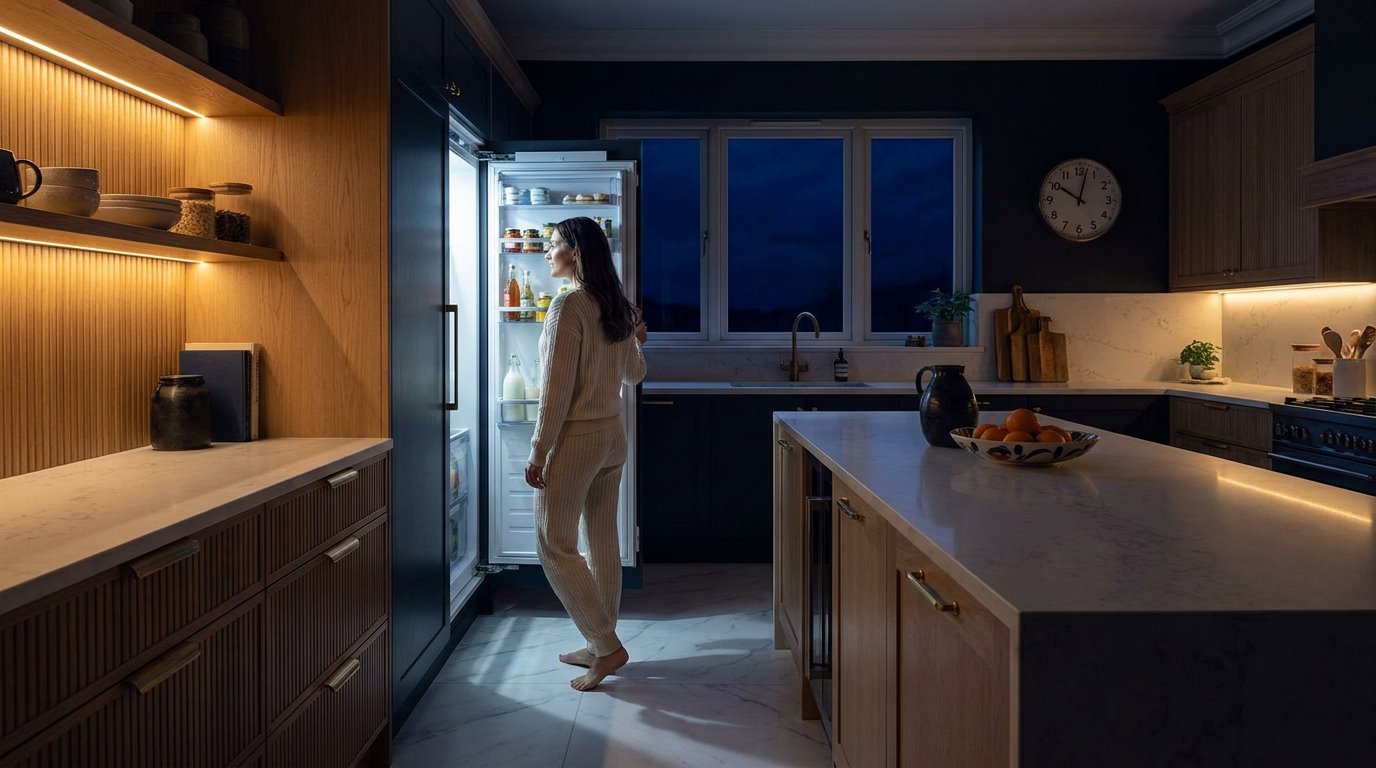
You get home at 9 p.m. Dinner happens at 9:30, because that is when it can happen. And somewhere in the back of your mind is a rule you have heard a hundred times: don't eat after 8.
Search the question and the first page of Google splits down the middle. Harvard Health, Cleveland Clinic and the Mayo Clinic say timing matters. WebMD, Healthline and university health pages say a calorie is a calorie, whenever you eat it. None of them explains why the other side exists.
The explanation is that they are citing different kinds of studies, which answer different questions. Once you see that, the rule about 8 p.m. falls apart — and something more useful takes its place.
Is "no food after 8 p.m." a real rule?
No study produced it. The rule is a folk simplification, and it is a bad one, because 8 p.m. is early for someone who sleeps at 1 a.m. and late for someone who sleeps at 9:30.
The cleanest evidence that the clock is the wrong variable comes from a 2017 study in the American Journal of Clinical Nutrition. Researchers tracked 110 college-age adults for 30 days, with all food intake photo-logged across 7 consecutive days, then measured each person's body fat and the time their melatonin began to rise in the evening — the biological start of their night.[1]
People with more body fat ate the bulk of their calories closer to melatonin onset: about 1.1 hours closer, on average. But the clock time of their eating was not different from the leaner participants. The difference was not when they ate by the wall clock. It was when they ate relative to their own body's night.[1]
How much closer to their melatonin onset — the biological start of night — participants with higher body fat ate most of their calories, compared with leaner participants (p=0.009). Clock time of eating did not differ between the groups (p=0.72).
McHill et al., American Journal of Clinical Nutrition, 2017 (n=110, ages 18–22, 30-day cross-sectional study)The same study found no relationship between body fat and total calories, macronutrients, physical activity or sleep duration. That is an observational finding, not proof of cause. But it tells you which variable to watch: not the number on the clock, but the distance between your last meal and your body's night — in practice, how many hours before bed you eat.
What happens when you eat the same calories later?
This is where the "timing matters" side has real data.
In 2022, a team at Brigham and Women's Hospital published a randomized crossover trial in Cell Metabolism. Sixteen adults with overweight or obesity — only 5 of them women — went through two conditions in a tightly controlled lab: the same meals, the same calories, the same sleep schedule, activity and light exposure.
The only difference was that in one condition every meal was pushed 250 minutes later, roughly four hours.[2]
Eating late doubled the odds of being hungry during waking hours (p<0.0001). It shifted the ghrelin-to-leptin ratio toward hunger over 24 hours (p=0.006); 24-hour leptin (the fullness hormone) itself fell 6%, but that change was not statistically significant.
Waking energy expenditure fell by about 59 kcal per day — a 5% drop — and core body temperature was lower across the day. Fat-tissue biopsies showed gene expression shifting toward storing fat and away from breaking it down.[2]
Two things are worth stating plainly. First, this was a small trial run over days, not months. Second, the senior author reports lecture fees from Bayer, Philips, Vanda and Pfizer, described as unrelated to this work, and the first author reports consulting for Novartis.[2] Neither point erases the result. Both belong next to it.
A 2020 trial at Johns Hopkins got at the same question from a different angle. Twenty healthy adults, average age 26, ate an identical dinner at either 6 p.m. or 10 p.m., with bedtime fixed at 11 p.m. and wake time at 7 a.m.
The late dinner produced higher overnight glucose, a delayed triglyceride peak, higher cortisol, and less oxidation of the fat from the meal itself — the researchers had labeled it and could follow where it went.[3]
One detail from that trial matters later in this article: sleep did not change. Same sleep architecture, whether dinner was one hour or five hours before bed.[3]
Put the two together and the physiology is consistent. Same food, same calories, eaten closer to the body's night: more hunger, slightly less energy burned, less of the meal's fat oxidized, higher glucose. This is what Harvard and Cleveland Clinic are pointing at. They are not wrong.
So does eating late make you gain weight — or not?
Here is the honest two-part answer.
Part one: the physiology is real. The trials above are isocaloric — the calories were held constant — and they still found differences. "A calorie is a calorie" is true in a bomb calorimeter. It is less true in a person whose body is preparing for sleep.
Part two: the physiology does not automatically show up on the scale. The best test of that is the TREAT trial, published in JAMA Internal Medicine in 2020. Researchers randomized 116 adults with overweight or obesity to either eat only between noon and 8 p.m. for 12 weeks or keep eating three structured meals. No calorie targets, no diet advice — just the window.[4]
The difference in weight loss between the time-restricted group (noon to 8 p.m.) and the control group after 12 weeks — not statistically significant (p=0.63). In the in-person subgroup, lean mass index fell more in the time-restricted group.
Lowe et al., JAMA Internal Medicine, 2020 (TREAT, n=116)The time-restricted group lost 0.94 kg, the control group 0.68 kg. The gap between them was 0.26 kg, with a confidence interval that comfortably included zero. In the 50-participant in-person subgroup, appendicular lean mass index — muscle in the arms and legs — dropped significantly more in the fasting group (p=0.005).
The authors' conclusion: time-restricted eating "was not more effective in weight loss than eating throughout the day."[4] Disclosure applies here too: one author co-founded and holds shares in Keyto, a keto-diet company, and another reports ties to Medifast and Tanita.
So Vujović shows that late eating shifts the body toward hunger and storage. TREAT shows that shrinking the window, by itself, produced no more weight loss than eating throughout the day. Both are true. The mechanism is real; the lever, pulled alone, is weak.
Two more studies get cited constantly on this topic. One is almost always cited wrong. The other is almost never cited at all.
The first is the Spanish study behind the line "late eaters lose less weight." In 2013, researchers followed 420 people through a 20-week weight-loss program and found that late eaters lost less weight, and lost it more slowly (p=0.002), despite similar calorie intake, energy expenditure, appetite hormones and sleep.[5]
That is a striking result. But in Spain the main meal is lunch, and the cutoff in that study was 3 p.m. It is evidence about eating your biggest meal of the day late. It is not evidence about a 9:30 p.m. dinner in Ohio.
The second is more encouraging, and it points to what you can actually change. In a 12-week trial of overweight and obese women with metabolic syndrome, both groups ate about 1,400 calories a day. One group front-loaded them — 700 at breakfast, 500 at lunch, 200 at dinner.
The other reversed it — 200, 500, 700. The big-breakfast group lost more weight and more waist, reported less hunger and more fullness, and their triglycerides fell 33.6% while the big-dinner group's rose 14.6%.[6]
Same calories. Same foods. The difference was where in the day the bulk of them landed. That is a variable a person who gets home at 9 p.m. can still control.

Why does the gap between dinner and bed matter more than the clock?
Look again at what the trials manipulated. Gu's participants ate at 6 or 10 with an 11 p.m. bedtime: five hours before bed versus one. Vujović's meals moved 250 minutes closer to sleep. McHill's heavier participants ate 1.1 hours closer to melatonin onset. None of these studies tested "8 p.m." What they tested was distance to the body's night.[1][2][3]
That reframing changes the instruction from impossible to doable. "Eat dinner earlier" is useless to someone whose shift ends at 8:30. "Put more hours between your dinner and your bed" is not. It can be done from either end.
There is a second reason the gap matters, and it is what you will feel tonight rather than what a scale shows next month.
A 2005 case-control study in the American Journal of Gastroenterology compared 147 patients with gastroesophageal reflux disease against 294 matched controls and asked one question: how long between dinner and lying down?
People who went to bed less than 3 hours after dinner had 7.45 times the odds of reflux disease compared with those who waited 4 hours or more, after adjusting for smoking, alcohol and body mass index.[7]
The odds of gastroesophageal reflux disease in people who lay down less than 3 hours after dinner, compared with those who waited 4 hours or more (95% CI 3.38–16.4), adjusted for smoking, alcohol and BMI.
Fujiwara et al., American Journal of Gastroenterology, 2005 (147 patients, 294 controls)This was a questionnaire-based study, so the numbers carry some noise. But an odds ratio above 7 is a large effect, and it explains something the weight trials cannot: why "eat earlier" feels like it works even when the scale barely moves. The heartburn stops. The night goes better. That is a real result, and it comes from the gap, not the clock.
For someone who eats at 9 p.m., the working rule becomes: lie down at midnight or later if you can — or, if you can't, make that dinner smaller so there is less to reflux and less to store.
Is it the late dinner, or the late snacking?
Google serves two very different people the same article. One eats a full dinner at 9:30 because that is when work ends, then goes to bed. The other eats dinner at 7 and then grazes — chips, cereal, whatever is in the refrigerator — until midnight. They type the same search. They do not have the same problem.
A 2015 review in Nutrients drew exactly this line. Looking across the nighttime-eating literature, the authors concluded that the negative metabolic effects come from large, mixed meals eaten at night — the kind that combine substantial carbohydrate, fat and protein.
A small snack of roughly 150 calories made up of a single nutrient did not appear harmful. And in people with obesity, combining nighttime eating with exercise training made the adverse effects disappear.[8]
So the second person's problem is not really timing. It is unplanned calories that don't register as a meal — a pattern that adds up without ever feeling like eating. The first person's problem is closer to what the trials measured: a big meal, near the body's night, with a short gap before lying down.[2][3][8]
The fix for grazing is a real dinner that ends the day. The fix for a genuinely late dinner is next.
What should you do if you can only eat dinner late?
Here is a plan for the person who will keep eating at 9:30 because life requires it.
- Protect the gap, not the hour. Aim for 3 to 4 hours between your last real meal and lying down. The reflux data used 3 hours as the danger line and 4 hours as the comparison; the one controlled dinner trial compared roughly 1 hour to 5.[3][7] If dinner is at 9:30, that argues for staying upright until close to midnight — or moving the next item up the list.
- Shrink dinner and grow breakfast. The 1,400-calorie trial shifted 500 calories from dinner to breakfast without changing the total and got more weight loss, less hunger and better triglycerides.[6] A late dinner that is the smallest meal of the day is a different metabolic event from a late dinner that is the largest.
- Make the late meal protein-forward, not a mixed feast. The review evidence points at large mixed meals as the problem.[8] Lean protein and vegetables at 9:30 is a smaller ask of your overnight physiology than pasta, bread and dessert at the same hour.
- If you need something before bed, keep it small and simple. Around 150 calories of a single nutrient — a serving of Greek yogurt, a scoop of cottage cheese — did not look harmful in the review.[8] The line to avoid is the second dinner.
- Don't skip dinner to "make up for" the timing. Going to bed hungry tends to turn into grazing, which is the pattern that adds calories without a meal ever happening. A small, planned dinner beats an unplanned raid on the refrigerator.
And the honest endpoint, since no one else says it: there is no long same-calorie trial that tells you how many pounds a late dinner costs over a year. The mechanisms have been measured for days. The effect on the scale over months has not been isolated from everything else. Anyone who gives you a number is guessing. What you can control tonight is the gap, the size of the plate — and, as the next section covers, the gut that late meal lands in.
Where supplements fit
Timing and composition are two levers. What lives in your gut is a third.
Everything above is about when you eat and what the meal looks like. Those are the levers the trials tested, and they belong in any plan. A daily capsule works alongside those levers, not instead of them — which is exactly why it suits a schedule that can't move dinner.
What none of the timing levers touch is the gut bacteria your food lands in. That is a separate lever, and it is where a daily gut product sits.
SLIMTIDE is a once-daily synbiotic capsule: prebiotic fiber plus live cultures in one pill. It's made in the USA in an FDA-registered, GMP-certified facility, contains no stimulants, and comes with a 60-day money-back guarantee — two months to run your own test, with fine print worth reading first: use it at least 30 days, and return shipping is on you.
Might make sense if
- Your schedule forces a late dinner and you want daily gut support that doesn't depend on timing
- You'd rather one non-stimulant capsule than a shelf of bottles
- You want a 60-day money-back guarantee as a safety net while you try it
- You value a US-made, GMP-certified product
- You're already fixing the gap and the meal, and want to cover the third lever too
Skip it if
- You expect it to replace the dinner-to-bed gap
- You're pregnant, nursing, or on medication (talk to your doctor first)
- You'd rather buy and measure the raw ingredients separately
Affiliate link — we may earn a commission at no cost to you. Full disclosure.
When should you see a doctor?
You have heartburn at night more than twice a week, food or sour liquid coming back up when you lie down, difficulty or pain when swallowing, or chest pain — reflux this frequent needs a proper evaluation, not a bigger gap before bed.
Also see a doctor for rapid weight gain with no change in your eating or activity, which is not a meal-timing story and deserves a look at thyroid, medications and fluid.
A late dinner that occasionally leaves you uncomfortable is not any of the above. But "it's just because I ate late" should not become the reason a nightly symptom goes unexamined for a year.
Frequently asked questions
Does eating after 8 p.m. make you gain weight?
Not because of the clock. No controlled trial has found that a specific hour causes weight gain. In a 30-day study of 110 young adults, clock time of eating did not differ between leaner and heavier people (p=0.72); what differed was how close to their biological night they ate. The 8 p.m. rule is a stand-in for a real variable: how many hours before bed you finish eating.
How many hours before bed should I stop eating?
The strongest number comes from reflux research, not weight research: eating dinner less than 3 hours before bed was linked to 7.45 times the odds of reflux disease compared with 4 hours or more. The one controlled dinner trial compared roughly 1 hour versus 5 hours before sleep. A gap of 3 to 4 hours is a reasonable target; if that is impossible, a smaller dinner is the next best move.
Is it better to skip dinner if it's too late?
Usually not. Skipping dinner tends to shift calories into unplanned snacking, and the review evidence points to large mixed meals eaten close to bedtime as the problem, not food itself. A smaller, protein-forward dinner eaten with a gap before bed is a more realistic plan than going to bed hungry.
Does eating late at night affect sleep?
In the most controlled test, a 10 p.m. dinner did not change sleep architecture compared with a 6 p.m. dinner in 20 healthy adults who went to bed at 11 p.m. What can disturb sleep is reflux: a short dinner-to-bed gap raised the odds of reflux disease more than sevenfold in a case-control study. If late meals wreck your sleep, heartburn is the more likely reason than the calories.
Will a small snack before bed make me gain weight?
The evidence does not suggest so. A 2015 review concluded that the negative effects of nighttime eating come from large mixed meals, while a small single-nutrient snack of around 150 calories did not appear harmful. Calories still count, but a modest snack is a different situation from a full late dinner.
Does intermittent fasting work by changing meal timing?
Not on its own. In the TREAT trial, 116 adults with overweight or obesity ate only between noon and 8 p.m. for 12 weeks without other instructions. The difference from the control group was 0.26 kg and not statistically significant (p=0.63), and the fasting group lost lean mass. Shrinking the eating window changes physiology, but on its own it produced no more weight loss than the control group.
Sources
- McHill AW, Phillips AJ, Czeisler CA, et al. "Later circadian timing of food intake is associated with increased body fat." American Journal of Clinical Nutrition, 2017;106(5):1213–1219. pubmed.ncbi.nlm.nih.gov/28877894
- Vujović N, Piron MJ, Qian J, et al. "Late isocaloric eating increases hunger, decreases energy expenditure, and modifies metabolic pathways in adults with overweight and obesity." Cell Metabolism, 2022;34(10):1486–1498. pubmed.ncbi.nlm.nih.gov/36198293
- Gu C, Brereton N, Schweitzer A, et al. "Metabolic Effects of Late Dinner in Healthy Volunteers — A Randomized Crossover Clinical Trial." Journal of Clinical Endocrinology & Metabolism, 2020;105(8):2789–2802. pubmed.ncbi.nlm.nih.gov/32525525
- Lowe DA, Wu N, Rohdin-Bibby L, et al. "Effects of Time-Restricted Eating on Weight Loss and Other Metabolic Parameters in Women and Men With Overweight and Obesity: The TREAT Randomized Clinical Trial." JAMA Internal Medicine, 2020;180(11):1491–1499. pubmed.ncbi.nlm.nih.gov/32986097
- Garaulet M, Gómez-Abellán P, Alburquerque-Béjar JJ, Lee YC, Ordovás JM, Scheer FA. "Timing of food intake predicts weight loss effectiveness." International Journal of Obesity, 2013;37(4):604–611. pubmed.ncbi.nlm.nih.gov/23357955
- Jakubowicz D, Barnea M, Wainstein J, Froy O. "High caloric intake at breakfast vs. dinner differentially influences weight loss of overweight and obese women." Obesity, 2013;21(12):2504–2512. pubmed.ncbi.nlm.nih.gov/23512957
- Fujiwara Y, Machida A, Watanabe Y, et al. "Association between dinner-to-bed time and gastro-esophageal reflux disease." American Journal of Gastroenterology, 2005;100(12):2633–2636. pubmed.ncbi.nlm.nih.gov/16393212
- Kinsey AW, Ormsbee MJ. "The health impact of nighttime eating: old and new perspectives." Nutrients, 2015;7(4):2648–2662. pubmed.ncbi.nlm.nih.gov/25859885
This article is for general information and education only. It is not medical advice, diagnosis, or treatment, and it is not a substitute for the judgment of a qualified healthcare provider who knows your history. Frequent nighttime heartburn, regurgitation, difficulty swallowing, chest pain, or unexplained weight change should be evaluated by a doctor. Always talk to your doctor, registered dietitian, or pharmacist before changing your diet or starting any supplement.
These statements have not been evaluated by the Food and Drug Administration. Any product mentioned is not intended to diagnose, treat, cure, or prevent any disease.