
The short answer
Feeling shaky when you skip a meal is usually an adrenaline response, not dangerously low blood sugar. In people without diabetes, glucose is often normal when the symptoms hit. The meal you ate before matters as much as the one you missed. Eat protein plus fiber, and see a doctor if it keeps happening.
It's 1:30 p.m. Breakfast was a bagel at seven, and lunch didn't happen. Now your hands have a fine tremor and your heart is tapping faster. Most people call this "low blood sugar." Usually, in someone without diabetes, it is the body's alarm firing before the sugar gets low — and the alarm was set at seven.
Why do you feel shaky when you skip a meal?
As glucose drifts down, your body releases counterregulatory hormones — glucagon, adrenaline, growth hormone, cortisol — to push it back up. Adrenaline is what you feel: tremor, fast heartbeat, sweating, unease.[2]
The order matters. Pittsburgh researchers lowered the glucose of 10 healthy volunteers in steps and recorded what happened at each level.[2]
Where glucagon and adrenaline release began in healthy adults — about 3.8 mmol/L, just below the normal fasting range. Shakiness, anxiety, sweating and palpitations began at about 58 mg/dL; hunger, dizziness and difficulty thinking at about 51.
Mitrakou et al., American Journal of Physiology, 1991 (n=10 healthy volunteers, hyperinsulinemic clamp)So the hormones fire first, at a glucose only slightly below normal. The shaky, anxious feeling is the hormone, not the number — alarming without being dangerous.
Is your blood sugar actually low if you don't have diabetes?
Usually not. In 1981, researchers gave real mixed meals to 18 patients referred for suspected reactive hypoglycemia. No one's glucose fell low — the mean was 79 mg/dL, about 4.4 mmol/L, normal. Yet 14 of the 18, or 78%, had hypoglycemia-like symptoms anyway. The authors proposed the name "idiopathic postprandial syndrome" to drop the assumption that sugar was low.[3]
This is why the Endocrine Society guideline requires Whipple's triad before evaluating hypoglycemia: symptoms, a measured low glucose at the same moment, and relief when glucose is raised.[4] Without a meter reading during an episode, "I get low blood sugar" is a guess.
Is it the meal you skipped, or the one you ate before?
Here is what the usual advice misses. When a real drop does happen in someone without diabetes, it is typically reactive: the Mayo Clinic describes it as occurring after a meal, usually within four hours.[5]
The mechanism is a mismatch. Fast carbohydrate with little protein, fat or fiber — the bagel, the sweet coffee, the white toast — spikes glucose, insulin follows, and glucose falls faster than the insulin does. A review in Diabetes & Metabolism ties reactive hypoglycemia to a high-carbohydrate, low-fat eating pattern, more common in very lean people and after large weight loss.[6]
A 7 a.m. bagel can leave you feeling it by 11. Skip lunch on top of that, and by 1:30 the alarm is loud. So the question is not only "why didn't I eat?" It is "what did I eat last?" Two people skip the same lunch; the one who had eggs and oatmeal often gets through it, and the one who had a pastry does not. See also the 3 p.m. crash and how long to wait between meals.
What should you do right now?
It depends on whether you take medication that lowers glucose.
- If you have diabetes and use insulin or a sulfonylurea (a common type of diabetes pill, such as glipizide or glimepiride), treat shakiness as possible hypoglycemia. The NIDDK protocol: 15 to 20 grams of fast carbohydrate — 4 ounces of juice, or glucose tablets — wait 15 minutes, check again, and repeat if still below 70 mg/dL (about 3.9 mmol/L). Your doctor's plan overrides this page.[1]
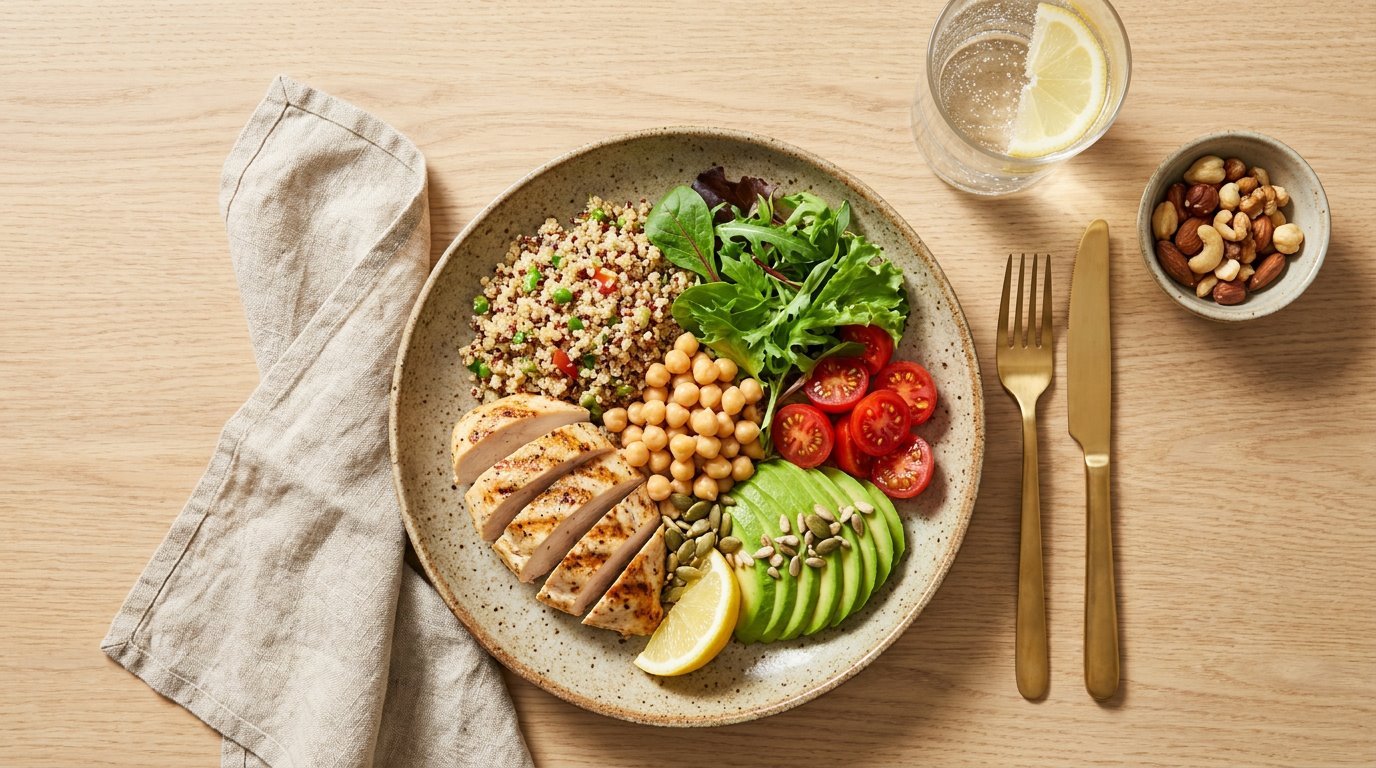
- If you don't have diabetes, you don't need juice. Sit down and eat something small that pairs carbohydrate with protein: yogurt and fruit, cheese and crackers, nuts and an apple. Pure sugar may restart the cycle.
What should you eat so it doesn't come back?
The lever is the shape of the meal before the gap.
Protein. In a Tufts trial, adding 50 grams of protein to a white-bread challenge lowered the glucose rise over the next two hours; smaller amounts made no clear difference.[8] See our protein guide for realistic amounts.
Fiber. Across fixed-calorie studies, more fiber increased post-meal fullness and reduced hunger at the next meal; eating freely, an extra 14 grams a day went with about 10% lower calorie intake.[9] Fiber's job is staying power: fullness lasts longer. Mayo's advice for reactive symptoms is the same plate, with smaller meals about three hours apart.[5] Our fiber guide lists the foods.
What you control is the plate before the gap. Most Americans get only about 15 grams of fiber a day, half the recommended amount.[9] So the plate comes first — and a simple daily gut habit can sit alongside it.
Where a daily gut habit fits
The plate is the main lever. A daily synbiotic is a simple habit to add alongside it.
Build meals that last, with protein and fiber. Alongside them, a once-daily capsule keeps a gut-support habit consistent, even on rushed mornings.
SLIMTIDE is a once-daily synbiotic capsule: prebiotic fiber plus live cultures in one pill, as daily support for the gut your meals land in. It's made in the USA in an FDA-registered, GMP-certified facility, is non-GMO, contains no caffeine or stimulants, and comes with a 60-day money-back guarantee — two months to run your own test, with fine print worth reading first: use it at least 30 days, and return shipping is on you.
Might make sense if
- You're rebuilding meals around protein and fiber and want a simple daily gut-support habit that doesn't depend on the fridge
- You want a 60-day money-back guarantee while you try it
- You value a US-made, GMP-certified, non-GMO product
Skip it if
- You're looking for a stimulant or an immediate energy boost — this isn't that
- You take insulin or a sulfonylurea — talk to your doctor before adding any supplement
- You'd rather buy and measure the raw ingredients separately
Affiliate link — we may earn a commission at no cost to you. Full disclosure. Our SLIMTIDE review covers the label, price and guarantee.
Does coffee on an empty stomach make the shakes worse?
It can. Caffeine stimulates the same hormone that causes the tremor. In a randomized crossover study of nine healthy non-coffee-drinkers, a single 250 mg dose — about two to three cups — after an overnight fast roughly tripled blood adrenaline (a 207% rise).[7]
The study tested only non-coffee drinkers, so regular drinkers may respond less, and it was small. But coffee, no breakfast, then a skipped lunch stacks adrenaline on adrenaline. The stomach side is covered in why coffee on an empty stomach makes you feel sick. Same fix: eat before the coffee.
Is it anxiety or low blood sugar?
The two share a chemistry. In the Pittsburgh study, "anxiety" was on the list of symptoms that appeared at 58 mg/dL, next to palpitations, sweating and tremor.[2] Three questions separate them:
- Does it track meals? Symptoms a few hours after eating or on days you skip a meal, and rarely on regular days, point to food.
- Does eating end it within about 15 minutes? Food resolves the glucose version, not a panic episode.
- Was your last meal mostly fast carbohydrate? A pastry or sweet coffee a few hours ago fits the reactive pattern.
Three yeses: the plate is the likely culprit. Three noes, with symptoms that arrive regardless of eating or caffeine: that deserves its own evaluation. Constant hunger with no trigger is a different pattern — see why you're always hungry.
When should you see a doctor?
If you use insulin or a sulfonylurea, treat any shaky episode as possible hypoglycemia and follow your doctor's plan. These medicines are the most common cause of true low blood sugar, and a skipped meal on them can drop glucose too far.[1][4]
Everyone else — book an appointment if:Episodes are frequent despite regular meals, you have a confirmed glucose below 70 mg/dL without diabetes, you are losing weight without trying, or shakiness comes with unusual thirst or frequent urination.
Get emergency help if:There is confusion, fainting, or a seizure, or someone cannot safely eat or drink — call 911. Very low glucose can affect the brain.[1]
Frequently asked questions
Why do I get shaky and weak when I don't eat?
Because your body releases adrenaline as glucose drifts down, and adrenaline causes tremor, a fast heartbeat and sweating. In a lab study that lowered glucose in controlled steps in 10 healthy adults, hormone release began at about 68 mg/dL and shaky symptoms at about 58 — not a dangerous range for most people without diabetes.
Is feeling shaky after skipping a meal a sign of diabetes?
On its own, no. Shakiness between meals is common in people without diabetes, and their glucose is often normal when it happens. Diabetes is diagnosed by high blood sugar, not hunger symptoms. If it comes with unusual thirst, frequent urination or unexplained weight loss, ask for a blood test.
How long after eating does reactive hypoglycemia happen?
Usually within four hours of a meal, according to the Mayo Clinic. That is why a shaky mid-afternoon often traces back to a fast-carbohydrate lunch rather than a skipped snack. True reactive hypoglycemia, with measured low glucose, is uncommon; symptoms with normal glucose are far more frequent.
What should I eat when I feel shaky from not eating?
If you have diabetes and a meter, follow your plan: 15 to 20 grams of fast carbohydrate, recheck in 15 minutes. If you don't have diabetes, a small snack pairing carbohydrate with protein and fiber — yogurt with fruit, or an apple with nuts — is enough to settle the symptoms; you don't need juice or candy.
Can skipping meals cause anxiety?
It can feel identical to anxiety, because anxiety is one symptom of the adrenaline response to falling glucose, alongside palpitations, sweating and tremor. If the feeling fades within 15 minutes of eating and returns on days you skip meals, food is the likely cause. If it appears regardless of eating, get it evaluated.
Sources
- National Institute of Diabetes and Digestive and Kidney Diseases. "Low Blood Glucose (Hypoglycemia)." NIDDK, U.S. Department of Health and Human Services. niddk.nih.gov
- Mitrakou A, Ryan C, Veneman T, et al. "Hierarchy of glycemic thresholds for counterregulatory hormone secretion, symptoms, and cerebral dysfunction." American Journal of Physiology, 1991;260(1 Pt 1):E67–E74. pubmed.ncbi.nlm.nih.gov/1987794
- Charles MA, Hofeldt F, Shackelford A, et al. "Comparison of oral glucose tolerance tests and mixed meals in patients with apparent idiopathic postabsorptive hypoglycemia: absence of hypoglycemia after meals." Diabetes, 1981;30(6):465–470. pubmed.ncbi.nlm.nih.gov/7227659
- Cryer PE, Axelrod L, Grossman AB, et al. "Evaluation and management of adult hypoglycemic disorders: an Endocrine Society Clinical Practice Guideline." Journal of Clinical Endocrinology & Metabolism, 2009;94(3):709–728. pubmed.ncbi.nlm.nih.gov/19088155
- Mayo Clinic. "Reactive hypoglycemia: What can I do?" Mayo Clinic Expert Answers. mayoclinic.org
- Brun JF, Fedou C, Mercier J. "Postprandial reactive hypoglycemia." Diabetes & Metabolism, 2000;26(5):337–351. pubmed.ncbi.nlm.nih.gov/11119013
- Robertson D, Frölich JC, Carr RK, et al. "Effects of caffeine on plasma renin activity, catecholamines and blood pressure." New England Journal of Medicine, 1978;298(4):181–186. pubmed.ncbi.nlm.nih.gov/339084
- Meng H, Matthan NR, Ausman LM, Lichtenstein AH. "Effect of macronutrients and fiber on postprandial glycemic responses and meal glycemic index and glycemic load value determinations." American Journal of Clinical Nutrition, 2017;105(4):842–853. pubmed.ncbi.nlm.nih.gov/28202475
- Howarth NC, Saltzman E, Roberts SB. "Dietary fiber and weight regulation." Nutrition Reviews, 2001;59(5):129–139. pubmed.ncbi.nlm.nih.gov/11396693
This article is for general information and education only. It is not medical advice, diagnosis, or treatment, and it is not a substitute for the judgment of a qualified healthcare provider who knows your history. If you have diabetes and take insulin or a sulfonylurea, treat shakiness as possible hypoglycemia and follow your doctor's plan. Confusion, fainting, seizures, frequent episodes, a confirmed low glucose without diabetes, or unexplained weight loss should be evaluated by a doctor. Always talk to your doctor, registered dietitian, or pharmacist before changing your diet or starting any supplement.
These statements have not been evaluated by the Food and Drug Administration. Any product mentioned is not intended to diagnose, treat, cure, or prevent any disease.