The short answer
Eight hours in bed is rarely eight hours of sleep: subtract falling asleep, wake-ups, and early waking. Then ask whether you're sleepy or tired; they point different ways. Schedule matters too: in 60,977 adults, regularity predicted mortality better than duration. Run a two-week test; apnea signs mean seeing a doctor now.
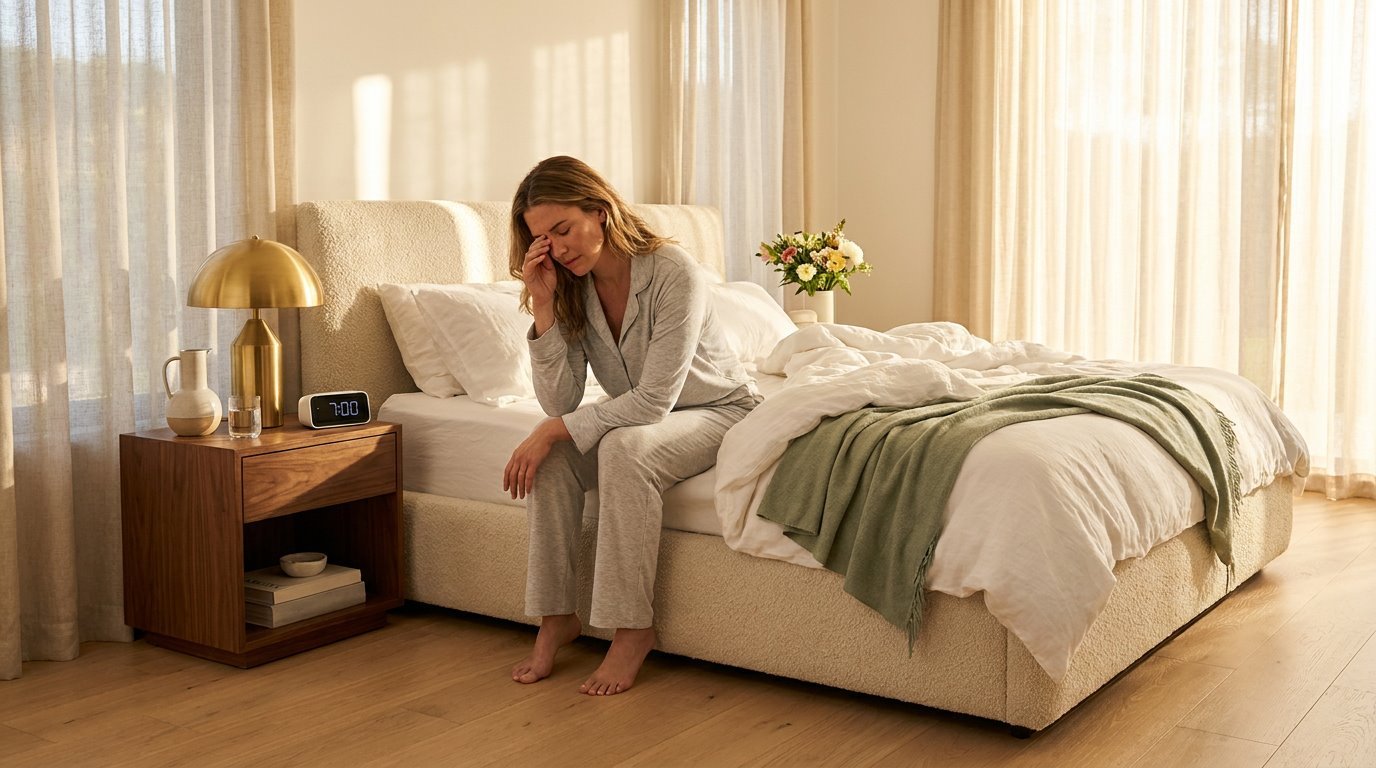
The alarm goes off. The math says you slept eight hours. Your body says otherwise — heavy limbs, a fog behind the eyes, a strong urge to lie back down.
Search the question and you'll get a list: apnea, thyroid, iron, stress, caffeine, your mattress. Sixteen suspects and no order to check them in. Most of those pages never ask the obvious thing — whether the eight hours actually happened.
This article works differently. Three checks first, in order. Most people find their answer in one of them without a single blood test.
Did you sleep 8 hours, or were you in bed for 8 hours?
Almost nobody does this arithmetic, and it changes everything.
Say you turned the light off at 10:30 p.m. and got up at 6:30 a.m. That's eight hours — on the clock. Now subtract the twenty minutes it took to fall asleep. Subtract three brief wake-ups you barely remember, five minutes each. Subtract the fifteen minutes you spent lying there after the alarm, not asleep and not up.
Sleep, not bed: about six and a half hours. The eight-hour night that "isn't working" was never an eight-hour night.
This is why "just sleep more" fails so many people. They add time in bed, which is the one variable that doesn't fix the gap. If you fall asleep slowly, wake often, or wake early and can't get back down, your total is shrinking at both ends and in the middle.
Sleep clinicians call the ratio between time asleep and time in bed sleep efficiency. You don't need a device to estimate yours. Two numbers — roughly when you fell asleep, roughly how long you were awake overnight — written down for a week will tell you more than any list of causes.
Are you sleepy, or are you tired?
These feel like the same word. In a sleep clinic they are two different complaints with two different workups, and telling them apart is the single most useful thing you can do before seeing anyone.
Sleepy means you would fall asleep if you let yourself. Sit in a quiet room at 2 p.m. with nothing to do — do you nod off? Do you drift on the couch, in a meeting, at a red light? That's sleepiness, and it points at the night: not enough real sleep, or sleep that is broken up.
Tired means drained, heavy, unmotivated — but if you lie down right now, you wouldn't sleep. You're exhausted and wired at the same time. That's fatigue, and it points away from the night, toward the day and the body.
The reason this matters: sleepiness after a full night is a sleep-quality problem, and the rest of this article is written for it. Fatigue without sleepiness, especially fatigue that looks the same every day regardless of how you slept, is a different pattern — the one the pillar guide calls Loop 4, where the fix is a doctor's visit, not a better bedtime.
If you read "would you nod off?" and thought never — I can't nap even when I want to, that's your answer, and it's worth taking to the pillar now. If you thought constantly, keep going.
If the drag only shows up in the afternoon and lifts by evening, that is a different pattern: the 3 p.m. crash.
Are they the same 8 hours every night?
Every sleep article you've read says the same thing: get seven to nine hours. You already do. So the advice is useless to you — and it's also missing the most important sleep finding of the past few years.
In 2024, researchers analyzed more than 10 million hours of data from wrist-worn activity trackers from 60,977 adults in the UK Biobank, then followed them for an average of 6.3 years.[1] They scored each person's sleep regularity — how consistent bedtime and wake time were from one day to the next — and compared it against sleep duration as a predictor of who died.
Lower risk of all-cause mortality across the four most regular fifths of the group, compared with the least regular fifth. Sleep regularity was a stronger predictor of mortality than sleep duration.
Windred et al., Sleep, 2024 (UK Biobank, n=60,977)Regularity won. Not how long people slept — how consistently they slept.[1] This is an observational study, so it shows association rather than cause, and the outcome it measured was mortality, not morning grogginess.
But it puts a number on something sleep researchers have suspected for a while: the body runs on timing, and a schedule that shifts by two or three hours between Tuesday and Saturday is a different physiological input from one that doesn't.
That weekly shift has an informal name — social jet lag — because the effect resembles flying across time zones every Friday and back every Sunday. Your Monday-morning eight hours are real. They're also landing on a body clock that was set for a different time zone the day before.
If your bedtime and wake time move around by more than an hour, you have found a suspect that no "7–9 hours" advice will ever catch.
Why do you feel worst in the first 30 minutes after waking?
Here is a quieter reason the eight hours feel like nothing: you're judging them at the worst possible moment.
The grogginess right after waking has a name — sleep inertia. Researchers define it as "a transitional state of lowered arousal" that produces a temporary drop in performance, and the key word is temporary. It dissipates as time awake increases.[2][3]
Two findings from the research matter here. First, sleep inertia shows up even after a normal eight-hour night — it isn't a sign that something went wrong.[2] Second, in the absence of major sleep deprivation, it rarely lasts more than 30 minutes, though it can run longer.[2]
What makes it worse is well described.
One of the most critical factors is which sleep stage you're pulled out of: an abrupt awakening during slow-wave sleep — deep sleep — produces more inertia than waking from lighter stages.[2]
Prior sleep loss makes it worse too, partly because a sleep-deprived brain spends more time in deep sleep, and the time of day you wake plays a role.[2][3]
One of the authors of the 2019 review reports speaker honoraria from a sleep research society — a minor conflict, noted for completeness.
This is also where the "wake up in multiples of 90 minutes" advice comes from, and where it falls apart. The idea is right in spirit — waking from deep sleep feels awful.
But the 90-minute figure is an average people repeat, not a measurement of your night. Cycles differ from person to person and change across the night, so counting backward from your alarm in neat blocks is precision the biology doesn't offer.
The practical conclusion is simple. Don't grade your night at 6:03 a.m. Grade it at 11 a.m. If you feel fine by mid-morning, you don't have a sleep problem — you have sleep inertia, which is normal and manageable. If you're still dragging at 11, keep reading.
What ruins sleep quality without shortening it?
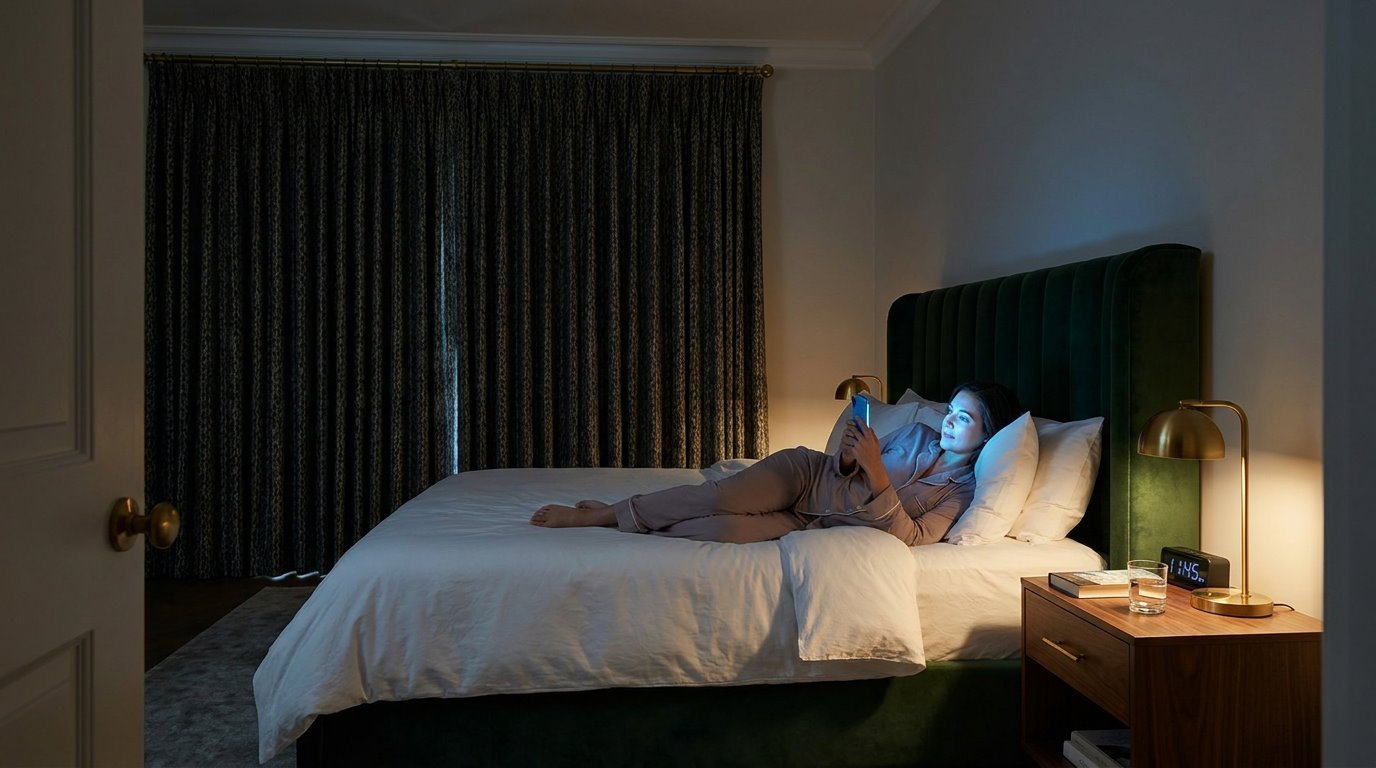
Assume the eight hours are real, you're sleepy rather than tired, and your schedule is steady. Then the question becomes what's happening inside those hours. Three things reliably degrade sleep while leaving the total on the clock untouched.
A glass or two of wine makes you fall asleep faster. That's not imagination.
A review of the studies on alcohol and normal sleep found that at all doses, alcohol shortens the time to fall asleep and makes the first half of the night more consolidated.[4]
Then comes the other half: an increase in sleep disruption in the second half of the night, at every dose studied. The first REM period is delayed at all doses, and total REM for the night is reduced at moderate and high doses.[4] You get a better first half and a worse second half — and the second half is the one you wake up from.
Sleep that is broken up by brief arousals — a snoring partner, a pet, a noisy street, a full bladder, breathing pauses you don't remember — can add up to eight hours and still leave you sleepy.
The literature review on this is blunt: fragmented sleep "is less restorative than consolidated sleep, and leads to sleepiness-related daytime impairment."[5] Many of these arousals are too short to remember in the morning. What you remember is the result.
No number here, on purpose — the studies that put a figure on screens and sleep are mixed, and we won't cite one we haven't checked.
The mechanism is not in dispute: bright light in the evening signals "daytime" to the brain's clock, and an engaging screen keeps the mind active past the point where it would otherwise wind down. Both push sleep onset later, which either shrinks your total or shifts your schedule — the two problems from Checks 1 and 3.
Caffeine belongs in this group too: in a controlled study, 400 mg (about four cups of coffee) taken a full six hours before bed still significantly disturbed sleep compared with placebo.[6]
What if my sleep tracker says I slept fine?
Consumer trackers infer sleep from movement and heart rate, not from brain activity. That makes the deep/REM breakdown the softest number on the screen — and because lying still reads as sleep, a tracker is likelier to overstate your total than to understate it. If the app says 7h50m, Check 1 is not settled yet. We are describing how the devices work, not citing a validation study.
So a "92% sleep score" is not proof that the night was restorative, and a low score is not proof that it wasn't. If the number is making you anxious about sleep, that anxiety can itself become the problem. Treat the tracker as a rough log of when you were in bed — and trust how you feel at 10 a.m. over the app.
Could it be sleep apnea even if you don't snore?
Yes. And this is where a lot of women stop reading too early.
Obstructive sleep apnea is common. A 2019 analysis in The Lancet Respiratory Medicine estimated that roughly 936 million adults aged 30 to 69 worldwide have mild-to-severe obstructive sleep apnea, and about 425 million have it moderately or severely.[7] One caveat you should know: that study was funded by ResMed, a company that makes CPAP machines, and several authors work there.
The estimate is widely cited, but the funding is relevant.
The picture most people have of apnea — a heavy man who snores loudly and stops breathing — is the picture that gets diagnosed. It is not the only picture.
Clinicians who see women with apnea describe a different presentation: less loud snoring, more fatigue, more insomnia-type complaints, more morning headaches. Those symptoms get read as stress or low mood first, and the sleep study comes years later, if at all. This is a clinical observation rather than a number we can cite — but it matters enough to say plainly.
Signs worth taking seriously, snoring or not:
- Waking with a dry mouth or a sore throat
- A headache in the first hour after waking
- Getting up to urinate during the night, more than once
- A partner who has noticed pauses, gasps, or choking sounds
- Feeling sleepy — the nod-off kind — despite a full night, most days
If two or more of those apply, the two-week test below is still worth running. But this is a case where you should also book the appointment now, not after.
How do you test this at home in two weeks?
Not a list of tips — an experiment, with a deadline. Two weeks is long enough to see a pattern and short enough that you won't drift. Change these things together and hold them steady:
- Hold both ends steady — same bedtime and same wake time, within about 30 minutes, weekends included. This is Check 3 made practical. The 2024 study scored the day-to-day consistency of sleep and wake timing, not just one of them; the 30-minute window is our practical rule, not a figure from the study.[1]
- No alcohol for 14 days. Not less — none. It's the only way to know whether the second-half disruption is yours.[4] Caffeine: last cup at least six hours before bed, and earlier is better — in the study, 400 mg (about four cups of coffee) taken a full six hours out still disturbed sleep.[6]
- Phone charges outside the bedroom. A plain alarm clock costs less than a week of coffee. This removes both the light and the scrolling in one move.
- Write down four things each morning: when you got into bed, roughly when you fell asleep, when you got up, and an energy score from 0 to 10 — taken at 11 a.m., not at the alarm.
- At day 14, look at the numbers. If your 11 a.m. score climbed and your sleep-versus-bed gap shrank, you've found it. If nothing moved — same fog, same scores, same gap — stop testing at home and make the appointment.
Most people who run this honestly discover that one of the three checks was the whole story. The ones who don't are exactly the ones a doctor needs to see.
One more group is worth naming before you go: people whose tiredness arrives with a stomach that never feels right. That is a different loop — and the one place a supplement earns a mention here.
Where supplements fit
Where a gut supplement fits — when your low battery comes with a bad gut
Sleep itself has no shortcut — the two-week test above is the fix for a night that wasn't eight hours. But the pillar guide lays out how often gut symptoms and fatigue travel together, and that is a piece the sleep test doesn't touch.
If your tiredness arrives with bloating, sluggish digestion, or a stomach that never feels settled, that's the Loop 3 territory — and it's the only place a gut supplement earns a mention in a sleep article.
SLIMTIDE is a once-daily synbiotic capsule: prebiotic fiber plus live cultures in one pill. It's made in the USA in an FDA-registered, GMP-certified facility, and it comes with a 60-day money-back guarantee — two months to run your own test, with fine print worth reading first: use it at least 30 days, and return shipping is on you.
To be clear: SLIMTIDE contains no caffeine and no stimulants. So it won't interfere with the sleep you're working on. It isn't a sleep aid or an energy pill — it's daily background support for the gut, the part of the fatigue picture that no bedtime change reaches.
Might make sense if
- Your tiredness comes with bloating or a gut that never feels settled
- You want one simple daily capsule, not powders and multiple bottles
- You prefer a non-stimulant product that doesn't touch your sleep
- You want a 60-day money-back guarantee as a safety net while you try it
- You value a US-made, GMP-certified product
Skip it if
- You're looking for a stimulant or an immediate energy boost — this isn't that
- You're pregnant, nursing, or on medication (talk to your doctor first)
- You'd rather buy and measure the raw ingredients separately
Affiliate link — we may earn a commission at no cost to you. Full disclosure.
When should you see a doctor?
Two weeks of a fixed schedule, no alcohol, and no phone in the bedroom changed nothing. Or if you have the apnea signs above — witnessed breathing pauses, morning headaches, waking to urinate, daytime nodding off.
Ask specifically about the STOP-Bang questionnaire, a short screening questionnaire doctors use for sleep apnea, and whether a sleep study makes sense for you. It's a two-minute conversation that many people never think to start.
And if what you have is fatigue rather than sleepiness — tired but unable to nap, the same on vacation as at work, unchanged by how you slept — the usual suspects are things like thyroid function, iron stores, and celiac disease. Those are blood tests, not sleep fixes, and they belong to a different article: the pillar guide's Loop 4 walks through them and what to ask for.
Frequently asked questions
Why do I wake up tired after 8 hours of sleep?
Three things are usually going on. Eight hours in bed can easily come out closer to six and a half hours of sleep once you subtract falling asleep, brief wake-ups, and the last stretch before you get up. The first 30 minutes after waking are dominated by sleep inertia, which shows up even after a normal 8-hour night. And an irregular schedule can leave you tired even when the total looks fine — in a study of 60,977 adults, sleep regularity predicted mortality better than sleep duration did.
Is it bad to sleep 8 hours and still feel tired?
It is common, and it is usually a measurement problem rather than a disease. Before assuming something is wrong, check whether you actually slept 8 hours, whether you are sleepy or just tired, and whether your bedtime moves around. Run a two-week test holding bedtime and wake time steady. If nothing changes, or if you have signs of sleep apnea, that is the point to see a doctor.
Does hitting snooze make you more tired?
It can, through sleep inertia. The grogginess right after waking is worst when you are pulled out of deep, slow-wave sleep. Each snooze cycle lets you drift back toward sleep and then interrupts it again, so you may be repeating the worst moment of the morning several times instead of once. Light, movement, and simply staying up tend to clear inertia faster than another nine minutes in bed.
Can a glass of wine at night affect my sleep?
Yes, and in a way that is easy to misread. A review of alcohol studies in healthy adults found that at all doses, alcohol shortens the time to fall asleep and makes the first half of the night more consolidated — which feels like better sleep. It then increases sleep disruption in the second half of the night and delays the first REM period at every dose. The early benefit is real; the later cost is what you notice in the morning.
Should I wake up in multiples of 90 minutes?
Ninety minutes is an average, not a timer you can set. Sleep cycles vary between people and change across the night, so counting backward from your alarm in 90-minute blocks gives a false sense of precision. What the evidence does support is the general point behind the idea: being woken abruptly from slow-wave sleep produces more grogginess than waking from lighter stages. A consistent wake time does more for that than arithmetic.
How do I know if I have sleep apnea?
You cannot confirm it at home, but you can spot the pattern. Loud snoring and witnessed breathing pauses are the classic signs. Less obvious ones include waking with a dry mouth or a morning headache, getting up to urinate during the night, and — especially in women — feeling exhausted or sleeping badly without much snoring at all. Clinicians describe that pattern, though we did not find a hard figure for it. If that sounds familiar, ask your doctor about the STOP-Bang screening questionnaire and whether a sleep study makes sense.
Sources
- Windred DP, Burns AC, Lane JM, et al. "Sleep regularity is a stronger predictor of mortality risk than sleep duration: A prospective cohort study." Sleep, 2024;47(1):zsad253. pubmed.ncbi.nlm.nih.gov/37738616
- Tassi P, Muzet A. "Sleep inertia." Sleep Medicine Reviews, 2000;4(4):341–353. pubmed.ncbi.nlm.nih.gov/12531174
- Hilditch CJ, McHill AW. "Sleep inertia: current insights." Nature and Science of Sleep, 2019;11:155–165. pubmed.ncbi.nlm.nih.gov/31692489
- Ebrahim IO, Shapiro CM, Williams AJ, Fenwick PB. "Alcohol and sleep I: effects on normal sleep." Alcoholism: Clinical and Experimental Research, 2013;37(4):539–549. pubmed.ncbi.nlm.nih.gov/23347102
- Stepanski EJ. "The effect of sleep fragmentation on daytime function." Sleep, 2002;25(3):268–276. pubmed.ncbi.nlm.nih.gov/12003157
- Drake C, Roehrs T, Shambroom J, Roth T. "Caffeine effects on sleep taken 0, 3, or 6 hours before going to bed." Journal of Clinical Sleep Medicine, 2013;9(11):1195–1200. pubmed.ncbi.nlm.nih.gov/24235903
- Benjafield AV, Ayas NT, Eastwood PR, et al. "Estimation of the global prevalence and burden of obstructive sleep apnoea: a literature-based analysis." The Lancet Respiratory Medicine, 2019;7(8):687–698. Funded by ResMed. pubmed.ncbi.nlm.nih.gov/31300334
This article is for general information and education only. It is not medical advice, diagnosis, or treatment, and it is not a substitute for the judgment of a qualified healthcare provider who knows your history. Loud snoring with breathing pauses, falling asleep while driving, persistent daytime sleepiness, or fatigue that does not improve with rest should be evaluated by a doctor. Always talk to your doctor, registered dietitian, or pharmacist before changing your routine or starting any supplement.
These statements have not been evaluated by the Food and Drug Administration. Any product mentioned is not intended to diagnose, treat, cure, or prevent any disease.