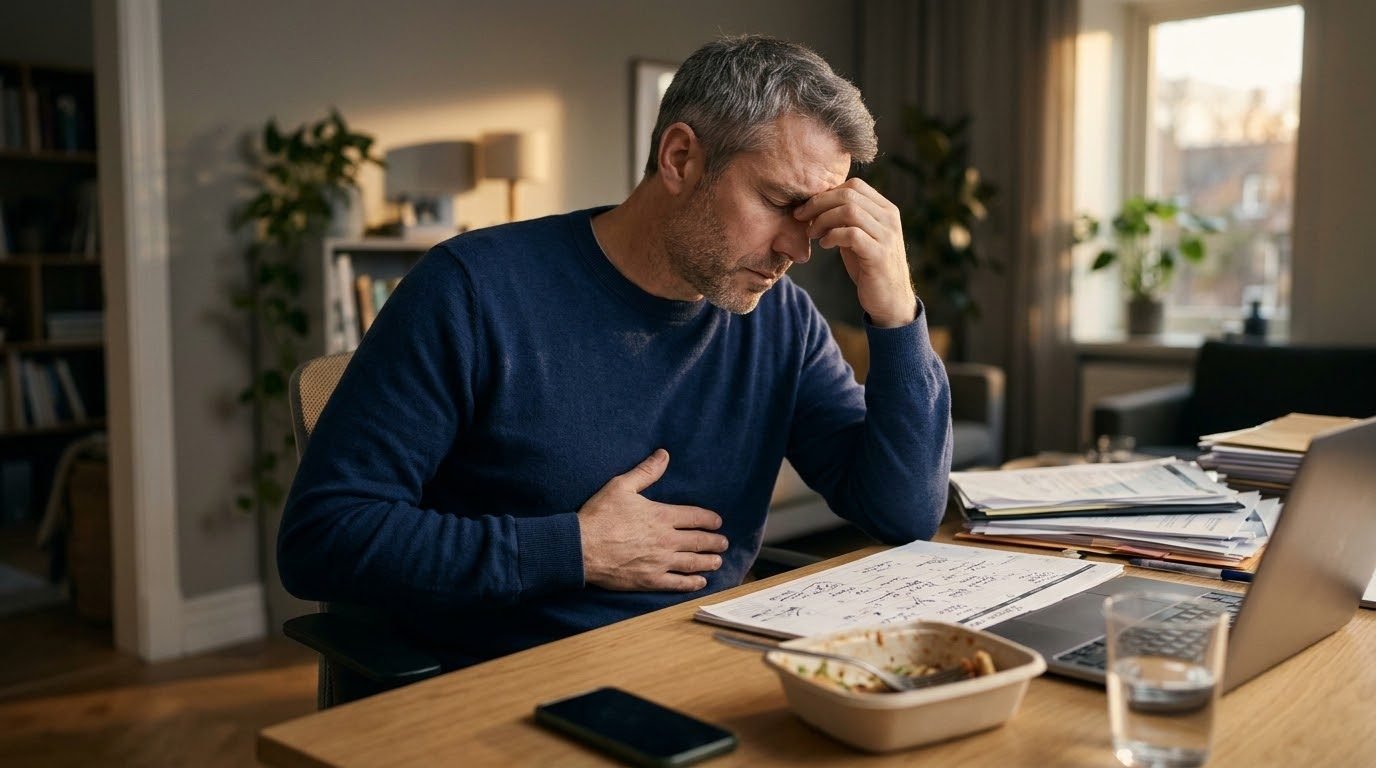
The short answer
Can stress cause bloating and stomach pain? Yes. Stress hormones slow the stomach, make the colon contract harder and leave the gut more sensitive to normal pressure, so the same meal can feel fine on a calm day and painful on a tense one. The tell is bloating that follows your calendar, not your plate.
You ate the same thing you always eat. By three o'clock your waistband is tight, your stomach aches, and nothing on the plate explains it. The explanation may be the meeting, not the meal.
This article is about one specific symptom: stress showing up as bloating and stomach pain. It's a different question from feeling drained all day; if you're still tired after eight hours of sleep, that guide covers sleep quality, which is its own problem. In our pillar guide to bloating and fatigue, this is Loop 3: symptoms that follow your sleep and your stress rather than your food. Here we take the stress half of that loop apart.
How does stress reach your stomach in the first place?
Through a two-way wire. Your gut has its own nervous system, and it talks to your brain constantly, through nerves and a set of stress hormones. Harvard Health describes the link as bidirectional: a troubled gut can send signals that produce anxiety, and an anxious brain can send signals that produce gut distress. The thought of food alone is enough to start the stomach releasing its juices.[1]
When you perceive a threat, a deadline or a hard conversation, the brain releases corticotropin-releasing hormone (CRH), the opening move of the stress response that ends in cortisol. A 2011 review in the Journal of Physiology and Pharmacology lays out what that cascade does downstream: it changes how fast the gut moves, how much it secretes, how permeable its lining is, how sensitive it is to pressure, and even which bacteria thrive there.[2]
A 2021 review in Gastroenterology adds the microbial layer: the gut bacteria sit on this same axis and influence motility and mood in both directions.[3] That's the theory. The useful part is what it does to a stomach at 3 p.m.
What does stress actually do to digestion?
Three things, each measured in people.
It makes the colon squeeze harder. In a small study published in Gut, researchers infused CRH, the stress hormone itself, into 10 people with IBS (irritable bowel syndrome) and 10 healthy controls. It triggered contractions in the descending colon in both groups, and the IBS patients responded more strongly, with higher stress hormone (ACTH) levels and longer-lasting abdominal symptoms.[4] The hormone alone, with no food involved, moved the colon.
It slows the stomach. Healthy young men ate a labeled pancake on separate occasions: at rest, and once followed by a 30-minute listening task designed to be mildly stressful. Under stress, the delay before the stomach began emptying stretched from about 11 minutes to 36.[5] Food sitting longer in the stomach is one plain route to that heavy, tight feeling after lunch.
How long a solid meal sat in the stomach before it started to empty, in healthy young men, during quiet rest versus a mild mental stress task. The overall emptying rate did not change significantly; the start of digestion simply stalled.
Roland et al., Nuclear Medicine Communications, 1990 (small physiology study; no funding statement in the PubMed abstract)It turns up the volume. A 2017 study in Pain gave 120 healthy volunteers either a standardized stress test, a mock job interview plus mental arithmetic, or a neutral task. Then everyone had a balloon gently inflated in the rectum, a standard way to measure gut sensitivity, after being told the saline infusion they'd received would help, hurt or do nothing. Negative expectations increased pain and urgency only in the people who had just been stressed.[6] Same pressure, more pain, once stress and a bad expectation met.
Cleveland Clinic calls this last mechanism visceral hypersensitivity: feeling bloated even when the amount of gas is normal, a pattern it links to IBS and other conditions "involving your gut-to-brain neural pathways."[7]
| What stress does | What it feels like | Where it was measured |
|---|---|---|
| Delays the stomach | Heavy, tight upper belly after a normal meal; food "just sitting there" | Healthy men, mental stress task: emptying start delayed 11 → 36 min[5] |
| Makes the colon contract harder | Cramping and gas that moves in waves; a stronger response in IBS | CRH infusion in 10 IBS patients and 10 controls[4] |
| Raises sensitivity | Normal gas feels like a lot; pain with no extra distension | 120 healthy volunteers after a standardized stress test[6] |
| Shifts secretions and barrier | Less predictable digestion day to day | Reviewed mechanisms, mostly from lab and animal work[2] |
Put the three together: food waits longer up top, the colon works harder below, and the nerves report all of it louder. That's bloating and stomach pain with nothing "wrong" on the plate.
How do you know it's stress and not your food?
By the pattern. Food-driven bloating follows the meal; stress-driven bloating follows the day. Five signs point toward stress:
- Same food, different outcome. The lunch you ate on Saturday without a problem leaves you distended on a tense Tuesday. If the plate didn't change, look at what did.
- It arrives with the rest of the stress kit. Stress shows up in the body as well as in mood, and Mayo Clinic's guide to stress symptoms covers both.[8] Notice a clenched jaw, a tight chest or shoulders up near your ears at the same time your stomach complains.
- Weekends and vacations are better. Not perfect, but noticeably easier, on the same groceries.
- It comes on fast. A hard email lands and the knot is there in minutes. Food takes hours to ferment; a stress signal takes seconds to arrive.
- You ate stressed. Lunch at the desk during a crisis, chewed in four minutes. Eating fast adds swallowed air, and eating in stress mode meets a stomach that is primed to stall.
If your bloating fails all five and instead tracks what you ate, especially high-fiber or fermentable foods, start with why vegetables can make you bloated instead. If it tracks the clock, worse every evening regardless of the day, that's Loop 1 in the pillar guide.
Where a synbiotic fits
Steady the gut side, while you work on the stress side.
No capsule treats stress, and this article isn't going to pretend otherwise. But the gut-brain axis runs both ways, and the reviews above put gut bacteria on that wire, mostly on the strength of animal research so far. A once-daily synbiotic is one way some people keep a steady fiber-and-live-cultures habit while the breathing test and the log below work on the stress side.
SLIMTIDE is a once-daily synbiotic capsule: prebiotic fiber plus live cultures in one pill. It's made in the USA in an FDA-registered, GMP-certified facility, is non-GMO, contains no caffeine or stimulants, and comes with a 60-day money-back guarantee, with fine print worth reading first: use it at least 30 days, and return shipping is on you.
No stimulants matters here: on a stressed system, caffeine-based "energy" products push the wrong direction. Take it at the same calm moment each day and judge it by your log, not by one bad afternoon. No trial in this article tested this product, and nothing here promises a result.
Might make sense if
- You want a simple daily gut habit that doesn't depend on how calm the day was
- Your plate is short on fiber and you'd rather not add a powder on busy days
- You're already running the breathing test and want the gut side covered too
- You value a US-made, GMP-certified, non-GMO product with no stimulants
Skip it if
- You expect a capsule to fix stress-related bloating on its own. It won't
- Your bloating is constant, painful, or comes with any red flag below. See a doctor first
- You're on a doctor-prescribed probiotic or IBS protocol. Keep following it
- You're pregnant, nursing, or on medication. Talk to your doctor first
Affiliate link — we may earn a commission at no cost to you. Full disclosure. Our SLIMTIDE review covers the label, price and guarantee.
What's a practical test you can run this week?
Two parts: a pause before eating, and a log that compares calm days with tense ones.
The pause. Before each main meal, sit down, put the phone face down, and take ten slow breaths that move your belly rather than your chest, about four seconds in and six out. That's roughly 90 seconds. The point is to let the nervous system shift out of threat mode before food arrives in a stomach that, as the emptying study showed, stalls under stress.[5]
The best evidence for this kind of breathing comes from reflux, not bloating. In a 2021 Mayo Clinic randomized trial, 23 patients with upright GERD and 10 controls were taught diaphragmatic breathing or a sham version. The breathing raised pressure at the valve between stomach and esophagus, and practiced after a meal it cut reflux events from 2.60 to 0.36 compared with simply being observed, though total acid exposure over a day was no different from the sham group.[9] The honest read: breathing changed what the gut did in the hour after eating, in a small trial, for a different symptom.
The honest caveat comes from the NIH. Its summary of IBS research cites a 2021 analysis of 6 studies in 278 people in which relaxation therapy was not helpful for abdominal pain or overall symptoms. A separate 2020 analysis found that mind-body approaches can help alongside medical treatment, with none clearly ahead of the others.[10] So treat the pause as a free, two-week experiment, not a prescription.

The log. Each evening, write three numbers: bloating 0 to 10, stomach pain 0 to 10, and stress 0 to 10 for the day. Add one word if you ate at your desk or in a hurry. After two weeks, sort the days by the stress column. If the bloating and pain numbers climb with it, on the same foods, you've found your loop. If they don't move with stress at all, look elsewhere, and the pillar guide's two-week log is built to do that sorting.
One more thing to protect in the same two weeks: sleep. Stress erodes it, and poor sleep then pushes appetite and gut symptoms the wrong way the next day. That's why the pillar treats sleep and stress as one loop.
Does chronic stress make bloating and IBS worse over time?
One striking piece of human evidence says yes, and it's older than most of the gut-brain hype. In a study published in Gut, 117 IBS outpatients were followed for 16 months while researchers tracked their chronic life stressors. The level of ongoing, threatening stress explained 97% of the variance in later symptom intensity. Not one patient living under a highly threatening chronic stressor improved by half over the period. It is a single study from one clinic, so read that 97% as a strong signal, not a law.[11]
The overlap with anxiety is large. A 2019 meta-analysis of 73 papers found that 39% of people with IBS had anxiety symptoms and 29% had depressive symptoms, about three times the odds of healthy controls.[12] That doesn't prove which came first; the axis runs both ways. It does mean that a stomach that has hurt for months is rarely just a food problem.
For everyday bloating without an IBS diagnosis, the lesson is proportion. A single stressful week that bloats you is the acute mechanism above. A stressful year that has left you bloated most days is the chronic one, and it deserves a conversation with a doctor about both the gut and the stress.
When should you see a doctor?
Lasts more than a week, is very painful, or comes with fever, vomiting, bleeding, weakness or unexplained weight loss. Those are Cleveland Clinic's cutoffs, and none of them is a stress pattern.[7]
Also ask if:Your bloating and pain are the same on calm days and tense days, wake you at night, or have gone on for months. Stress-related symptoms vary with stress; symptoms that never vary need a diagnosis. And if the stress itself feels unmanageable, that's a reason to see someone on its own, not an afterthought to the stomach.
Frequently asked questions
Can stress really cause bloating?
Yes. Stress hormones act on the gut directly: in a small human study, a stress hormone infusion made the colon contract harder, and in healthy volunteers a mild mental task delayed the start of stomach emptying from about 11 to 36 minutes. Food that sits longer and a colon that squeezes harder feels like bloating, with no change to what you ate. Cleveland Clinic puts it plainly: bloating that comes and goes usually involves stress.
Why does my stomach hurt when I'm anxious?
Two things happen at once. Stress signals change how your gut moves, so normal gas and stool press against a stomach and colon that are tense or out of rhythm. And stress turns up sensitivity: a 2017 study in 120 healthy volunteers found that negative expectations raised gut pain and urgency only in the people who had just been through a stress test. The same pressure hurts more on an anxious day.
Can stress cause bloating even if I eat the same foods?
Yes, and that is the clearest clue that stress is the variable. If the same lunch is fine on Saturday and leaves you distended on a tense Tuesday, the food did not change; the nervous system that digests it did. The pattern to look for is bloating that tracks your calendar rather than your plate.
Does deep breathing before eating help digestion?
Probably a little, and it costs nothing to test. Slow belly breathing is the simplest way to nudge the nervous system from stress mode toward rest-and-digest. A 2021 Mayo Clinic randomized trial found that breathing this way after meals cut postprandial reflux events from 2.60 to 0.36 in people with upright GERD. Trials for bloating specifically are lacking, so treat it as a two-week experiment, not a cure.
When is stress-related bloating actually something else?
When it stops following your stress. Cleveland Clinic says to see a doctor if bloating lasts more than a week, is very painful, or comes with fever, vomiting, bleeding, weakness or unexplained weight loss. Bloating that is identical on calm days and tense days, or that wakes you at night, is not a stress pattern and needs a diagnosis, not a breathing exercise.
Can chronic stress make IBS or bloating worse long-term?
The evidence says yes. In a 16-month study of 117 IBS patients, the level of chronic life stress explained 97% of the variance in later symptom intensity, and not one patient under a highly threatening ongoing stressor improved by half. A 2019 meta-analysis of 73 papers found 39% of people with IBS had anxiety symptoms, about three times the odds of healthy controls. Ongoing stress is a maintenance factor, not just a trigger.
Sources
- Harvard Health Publishing. "The gut-brain connection." Harvard Medical School, reviewed July 18, 2023. health.harvard.edu
- Konturek PC, Brzozowski T, Konturek SJ. "Stress and the gut: pathophysiology, clinical consequences, diagnostic approach and treatment options." Journal of Physiology and Pharmacology, 2011;62(6):591–599. Narrative review; the authors declare no conflict of interest. pubmed.ncbi.nlm.nih.gov/22314561
- Margolis KG, Cryan JF, Mayer EA. "The Microbiota-Gut-Brain Axis: From Motility to Mood." Gastroenterology, 2021;160(5):1486–1501. Review; public and foundation research funding (NIH, U.S. Department of Defense, Science Foundation Ireland, European Union). The authors disclose consulting, speaking or advisory ties to drug, nutrition and probiotic companies, including Takeda, Nestlé, Yakult and Danone. pubmed.ncbi.nlm.nih.gov/33493503
- Fukudo S, Nomura T, Hongo M. "Impact of corticotropin-releasing hormone on gastrointestinal motility and adrenocorticotropic hormone in normal controls and patients with irritable bowel syndrome." Gut, 1998;42(6):845–849. Small physiology study (10 IBS patients, 10 controls). PubMed lists non-U.S. government research support; the sponsor is not named in the abstract. pubmed.ncbi.nlm.nih.gov/9691924
- Roland J, Dobbeleir A, Vandevivere J, Ham HR. "Effect of mild mental stress on solid phase gastric emptying in healthy subjects." Nuclear Medicine Communications, 1990;11(4):319–326. Small physiology study in healthy young men; no funding statement in the PubMed abstract. pubmed.ncbi.nlm.nih.gov/2362744
- Roderigo T, Benson S, Schöls M, et al. "Effects of acute psychological stress on placebo and nocebo responses in a clinically relevant model of visceroception." Pain, 2017;158(8):1489–1498. 120 healthy volunteers; University Hospital Essen and University Hospital Tübingen, Germany. PubMed lists non-U.S. government research support; the sponsor is not named in the abstract. pubmed.ncbi.nlm.nih.gov/28471874
- Cleveland Clinic. "Bloated Stomach." Cleveland Clinic Health Library. my.clevelandclinic.org
- Mayo Clinic Staff. "Stress symptoms: Effects on your body and behavior." Mayo Clinic. mayoclinic.org
- Halland M, Bharucha AE, Crowell MD, Ravi K, Katzka DA. "Effects of Diaphragmatic Breathing on the Pathophysiology and Treatment of Upright Gastroesophageal Reflux: A Randomized Controlled Trial." American Journal of Gastroenterology, 2021;116(1):86–94. Mayo Clinic; small trial (23 patients, 10 controls) in reflux, not bloating. PubMed lists non-U.S. government research support; the sponsor is not named in the abstract. pubmed.ncbi.nlm.nih.gov/33009052
- National Center for Complementary and Integrative Health. "Irritable Bowel Syndrome: What You Need To Know." NCCIH, National Institutes of Health. nccih.nih.gov
- Bennett EJ, Tennant CC, Piesse C, Badcock CA, Kellow JE. "Level of chronic life stress predicts clinical outcome in irritable bowel syndrome." Gut, 1998;43(2):256–261. 117 IBS outpatients followed 16 months; no funding statement in the PubMed abstract. pubmed.ncbi.nlm.nih.gov/10189854
- Zamani M, Alizadeh-Tabari S, Zamani V. "Systematic review with meta-analysis: the prevalence of anxiety and depression in patients with irritable bowel syndrome." Alimentary Pharmacology & Therapeutics, 2019;50(2):132–143. 73 papers pooled; no funding statement in the PubMed abstract. pubmed.ncbi.nlm.nih.gov/31157418
This article is for general information and education only. It is not medical advice, diagnosis, or treatment, and it is not a substitute for the judgment of a qualified healthcare provider who knows your history. Bloating with unexplained weight loss, blood in the stool, persistent diarrhea, night pain, fever, vomiting or anemia should be evaluated by a doctor. People who are immunocompromised, seriously ill, pregnant, nursing, or taking medication should talk to their doctor before starting any probiotic, prebiotic or synbiotic. Always talk to your doctor, registered dietitian, or pharmacist before changing your diet or starting any supplement.
These statements have not been evaluated by the Food and Drug Administration. Any product mentioned is not intended to diagnose, treat, cure, or prevent any disease.